Built to converge / Designed to isolate
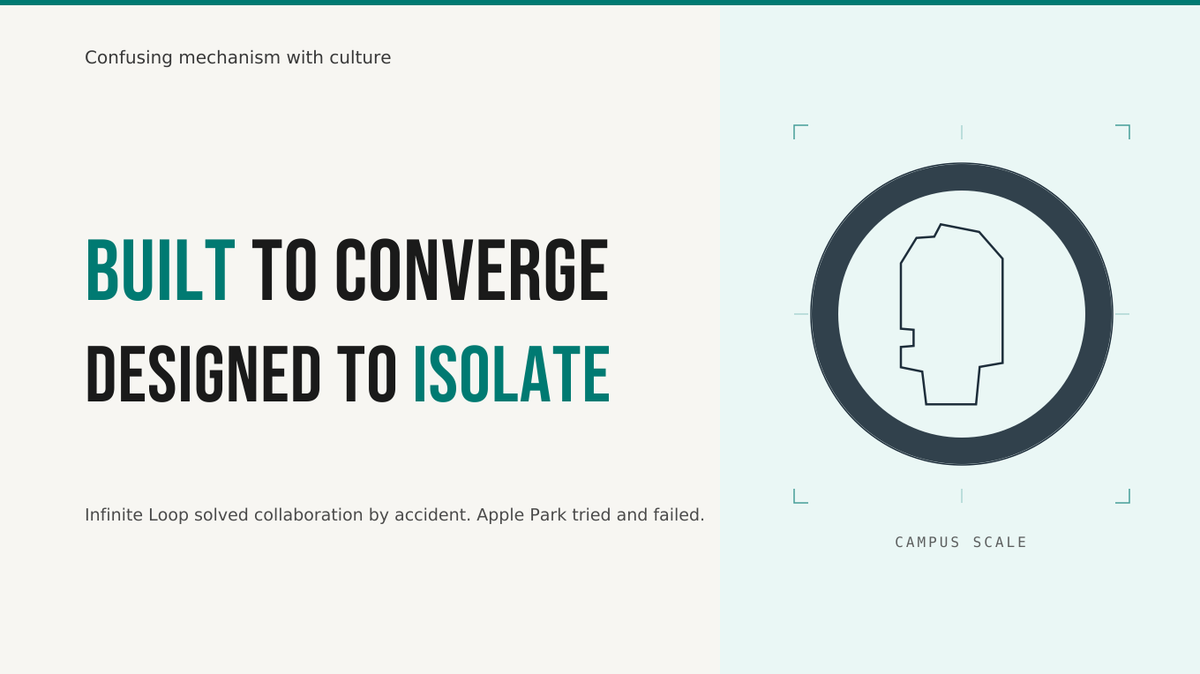
Apple Park's primary design goal was to foster collaboration and serendipitous interaction — almost the exact words Apple's own head of industrial design used to describe the building years after it opened, and consistent with what Jobs pitched to Cupertino's city council in 2011: a ring shape chosen specifically to eliminate hierarchical corners in favour of more egalitarian, encounter-friendly circulation. By most accounts from the people who actually work there, it's failed at exactly that.
The open-plan floors make it hard to concentrate. The building is so large that getting from one meeting to the next eats real time out of the day. It's common for people to run meetings with colleagues over Webex — colleagues on the same campus, sometimes no more than two hundred yards away.
Ironically, Apple Park replaced a campus that did far better on the same measure without ever trying to. Infinite Loop produced far more of the accidental, cross-team contact Apple Park was explicitly built to create. Working out why starts with what Infinite Loop got right by accident. It continues with what the research on office proximity says about why that kind of thing happens at all. And it ends with what Apple Park could become instead — including a version of the fix Apple already trusts enough to run for a hundred people a year.
Infinite Loop worked by accident
It's six buildings around a loop road, each distinctive enough that if you were walked in blindfolded and spun around, you'd know immediately which one you were facing the moment the blindfold came off. But it's also human scale, and that turns out to matter more than any deliberate design goal did.
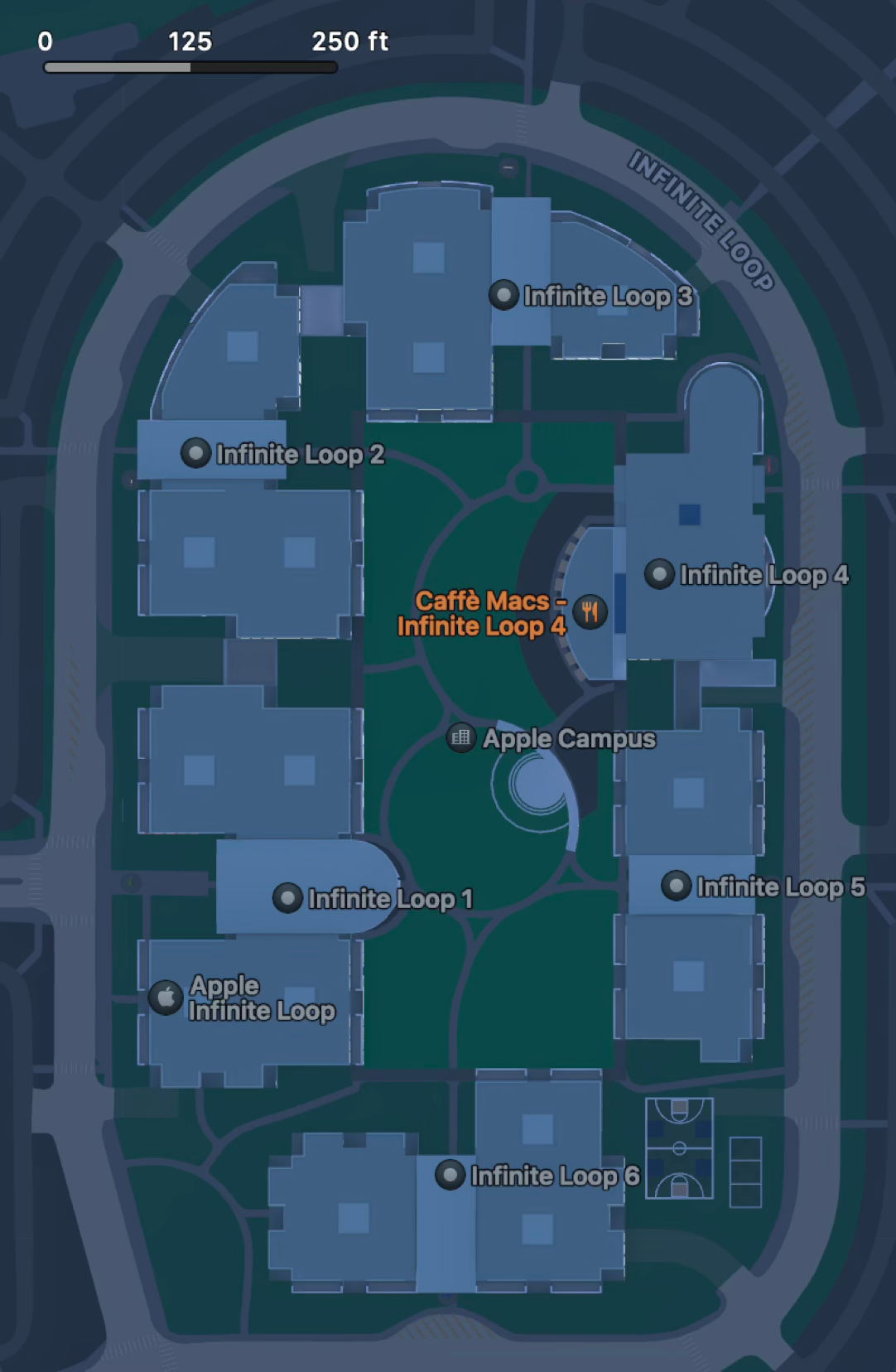
You could get from any part of the campus to any other in a few minutes, even when some areas were locked down. Caffè Macs fed the whole site and doubled as a gathering point. More important than either of those, IL1 had a large, open-plan entrance space that reached all the way up to the glass roof, with numerous couches and small sets of tables and chairs. And a coffee and snack bar. The kind of place where you could sit down with a laptop and be fairly confident that, sooner or later, the person you wanted to run into would walk past. If you buttonholed them, you could smooth it over by buying the coffee.
Whatever Sobrato's original brief called for — it was a fairly generic spec R&D campus, not something built around Apple's culture — nobody was specifically engineering Caffè Macs or the IL1 coffee bar to work as a place you could reliably run into someone. That was a side effect of the buildings being close enough together that people kept bumping into each other anyway. Which is exactly the ingredient Apple Park is missing.
The physical case against Apple Park
Apple Park is enormous in a way that's hard to appreciate until you've been there. The loop around the ring is about a mile. There's no obvious focal point for the whole site — most sections have their own sitting area and their own coffee bar, but nothing plays the role Caffè Macs and the IL1 coffee bar played together at Infinite Loop. Caffè Macs at Apple Park seats a thousand people and feels built for throughput, not conversation. Everything is organised per-segment rather than around a shared centre, which is convenient for the people in that segment and useless for the discovery-by-accident that made the old campus work.
The loss goes beyond seating capacity, too. Infinite Loop had Town Hall, a genuine auditorium seating a few hundred people with proper AV and recording facilities, used for company-wide meetings and talks. Apple Park has nothing like it. By multiple accounts from people who were there during design and construction, the site was flagged as under-provisioned for meetings and conferences before it even opened.
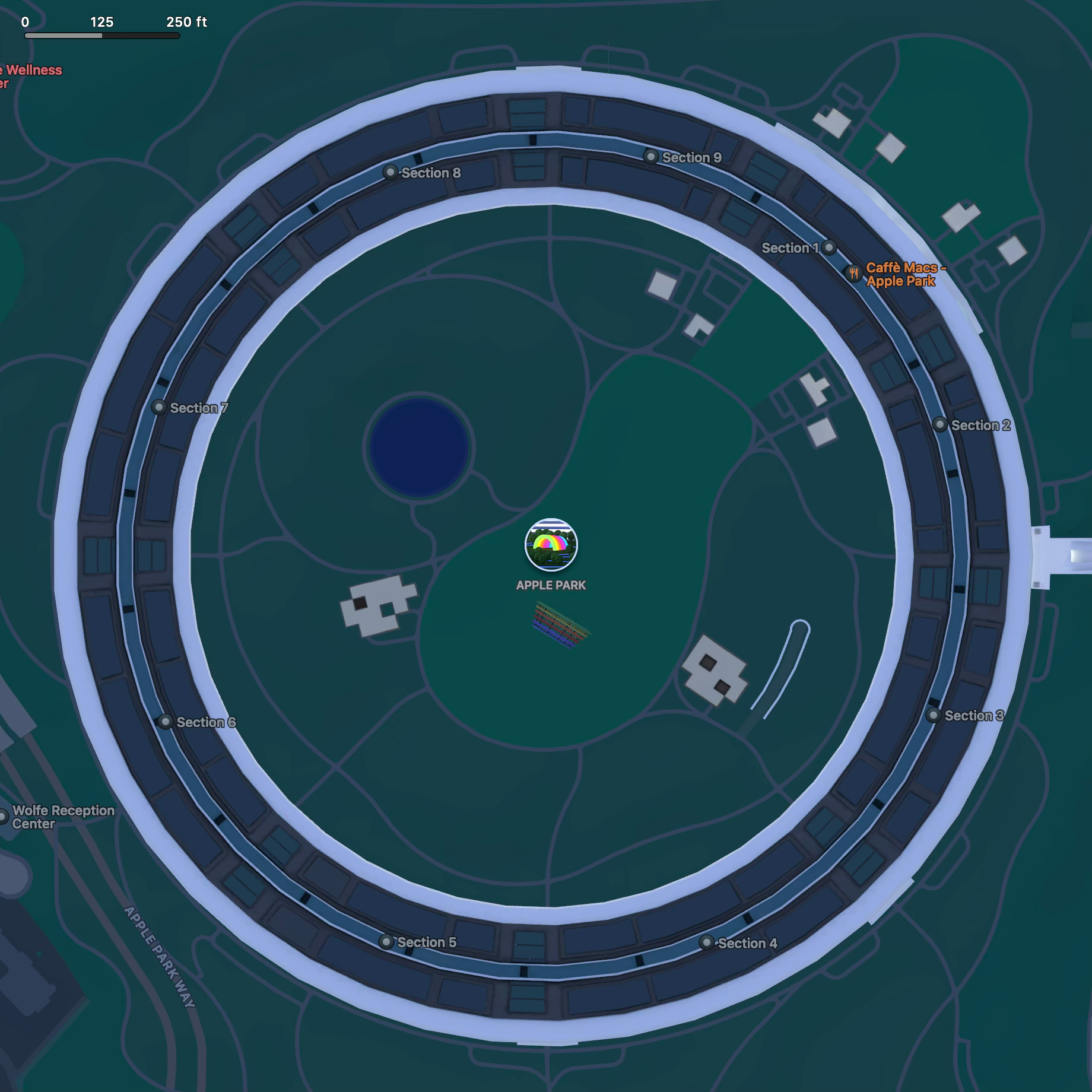
Rendered here, both maps probably fill the same width on the page, which makes it easy to assume they're showing places of similar size. They're not — and the image below is where that actually becomes visible.
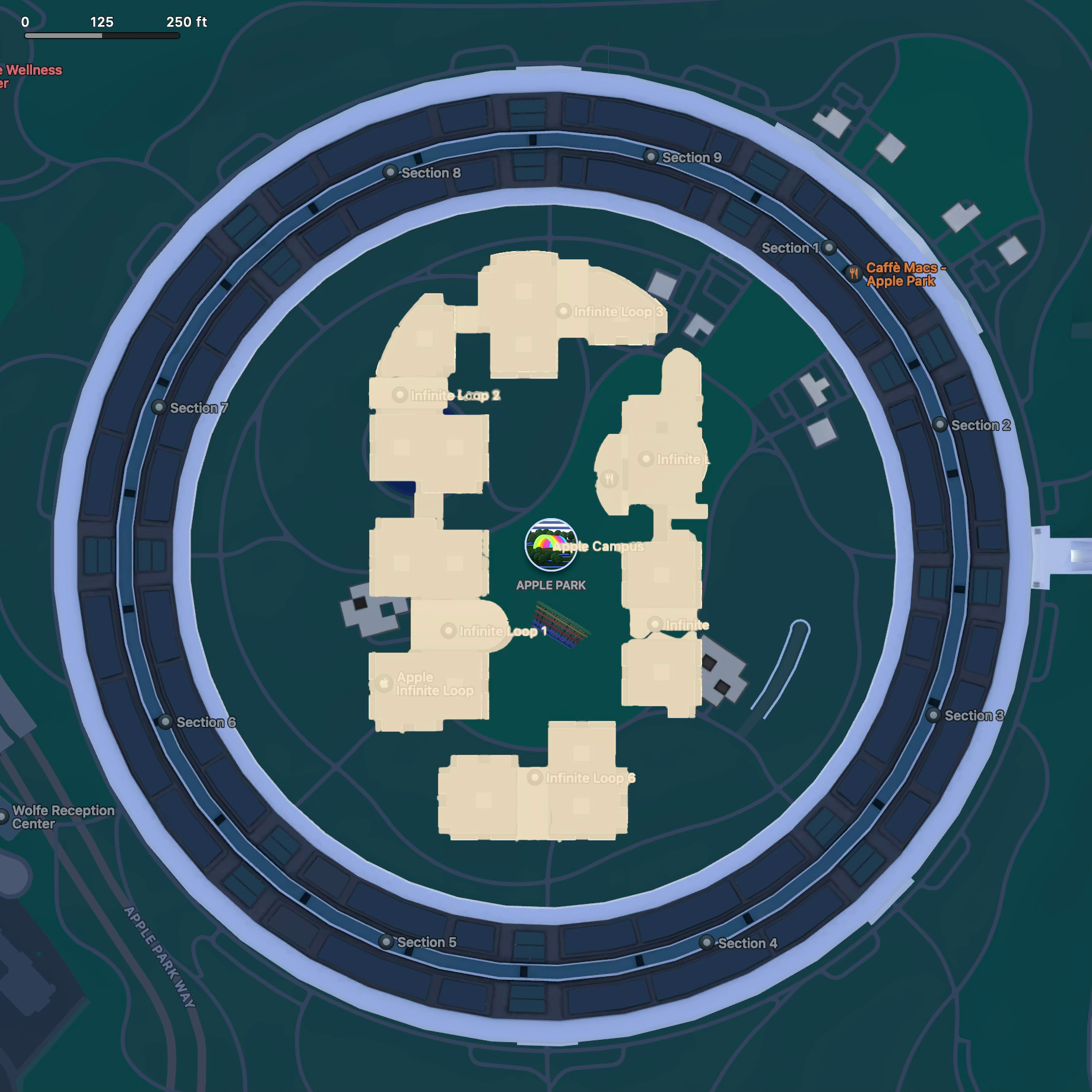
The old campus — all six buildings, the cafe, everything — fits inside about half of Apple Park's inner courtyard, with green space left over. And yet it serves fewer of the informal, collision-based needs that the old campus met more or less by accident.
Add to that the lockdown zones that come with product confidentiality, and the comparison gets sharper rather than simpler. Infinite Loop had these too — certainly by the early 2000s, when areas were closed off during iPhone development, and quite possibly earlier. The difference isn't that Apple Park introduced compartmentalisation Infinite Loop never had. It's what compartmentalisation costs at each scale. At Infinite Loop, routing around a locked-down area meant an extra flight of stairs or a short trip outside — a minor inconvenience, over in a minute. At Apple Park, the same kind of workaround can mean several flights of stairs and a genuinely long walk between segments. The lockdowns didn't get more frequent. The building just got big enough to make going around them expensive.
The research says the same thing
The pattern in those two campuses isn't unique to Apple. It's well documented, and has been for a long time.
The starting point is Thomas Allen's research from MIT in the 1970s, since collected in what's known as the Allen curve: the frequency of technical communication between engineers falls off sharply as the distance between their desks increases, with most of the effect gone by somewhere between 25 and 50 metres. That's decades old, but more recent, better-controlled studies keep landing in the same place. When MIT restructured its buildings between 2005 and 2015, pairs of researchers who ended up sharing a building started publishing roughly twice as many joint papers together (Miranda and Claudel, 2021) — a similarly-sized effect at a French university that had to relocate labs during a 17-year asbestos removal project, where colocated labs produced 2.5 to 3.3 times as many joint publications (Catalini, 2017). Inside a US co-working space, only the closest 25% of startups showed any sign of learning from each other's technology choices — "close" meaning within about 66 metres (Roche, Oettl and Catalini, 2022). A study of an entrepreneurship bootcamp in India found much the same drop-off, and — tellingly — found it was weakest among people who already knew each other before they arrived (Hasan and Koning, 2019).
That last detail matters, because it points to why proximity works. It isn't mainly that being close makes it easier to talk to people you already work with — modern tools have mostly solved that problem. It's that being close is what makes you discover people you had no reason to look for. Every one of the studies above finds the effect is strongest among people who wouldn't otherwise have known about each other, and weak or absent among people who already had a connection. Communication was never the scarce resource. Discovery was.
That reframes what Apple Park gets wrong. It isn't failing to keep existing collaborators in touch — Slack, Webex, and email do that fine regardless of distance. It's failing to produce the accidental meetings that create new collaborators in the first place.
It gets worse. Open-plan design, the specific choice much of Apple Park is built around, has been shown to actively work against its own goal. When two Fortune 500 companies moved from cubicles to open floors, researchers tracking employees with wearable sensors found face-to-face interaction dropped by around 70%, while email and instant messaging use rose to compensate (Bernstein and Turban, 2018). Stripping away walls didn't produce more spontaneous conversation. It made people more self-conscious about being watched, and they responded by putting on headphones and retreating into text. There's a specific irony in citing this study for a piece about Apple Park: the same research literature that documents open-plan's failure mode has, more than once, used a photo of Apple's own campus as the go-to illustration of the design philosophy it's debunking.
There's a useful complication worth stating plainly, though, rather than skating past it: full remote work isn't the answer either. A large study of Microsoft employees during the shift to company-wide remote work found that collaboration networks became measurably more siloed — people kept talking to the colleagues they already knew, and the loose, cross-team connections that don't have an obvious reason to happen on a video call quietly stopped happening (Yang et al., 2021). So the finding isn't "buildings are bad." It's narrower and more useful than that: what actually drives new collaboration is occasional, close-range, unscheduled contact between people who don't already have a reason to talk — and neither a mile-wide ring nor a fully remote company reliably produces that.
Which leaves a real question: is there a way to manufacture that kind of contact deliberately, without requiring several thousand people to work permanently in the same building? The same body of research has already started asking this. One review of the office-proximity literature — the same one this piece has been drawing on throughout — poses it directly: could an organisation get most of the discovery benefit of an office from a short, deliberately designed retreat instead of daily colocation? The answer from the academic conference literature it points to is a qualified yes, with an important distinction attached. Simply attending the same large conference as someone else raises the odds of later collaborating by something like 10–20% — real, but modest next to colocation's roughly doubling effect.
But the research on people meeting in small groups at conferences specifically finds a much larger effect, potentially reaching the same order of magnitude as full colocation (Clancy, 2022). The research doesn't specify what "small groups" looks like in practice, but a poster session is a reasonable stand-in — and it's the kind of format a week-long residency built around posters and small-group discussion would actually resemble, not a trade-show floor.
That's not a footnote. That's most of the argument for what Apple Park could become instead. Before getting on to that, though, there's a specific irony worth sitting with, because it involves the same person who greenlit Apple Park.
Jobs already knew this, in 1990
In a 1990 interview for the documentary series "The Machine That Changed the World," Steve Jobs described being able to assemble a working group of fifteen people in around fifteen minutes, regardless of where they were or who they reported to — a model he said already existed in higher education, and one he called "interpersonal computing."

That's a claim that physical distance barely matters, made by the same executive whose final, most expensive project bet everything on the opposite premise: that if you put everyone inside one very large ring, distance would stop being a problem on its own. The research above suggests his 1990 self had the better argument. Apple Park is a monument to solving a problem — distance — with more square footage, when the actual lever, as his younger self seemed to understand, was organised, intentional contact rather than passive shared real estate.
It's not even the first time Jobs tried to solve this with architecture, and the earlier attempt worked. At Pixar, he pushed for a single central atrium and had bathrooms sited there specifically so people from different departments — animators, engineers, executives — would end up crossing paths on the way. Pixar's chief creative officer at the time later credited the idea with working from day one. That's the same design philosophy Apple Park is built on, tested first at a much smaller scale: Pixar's building is 218,000 square feet for around 700 people, against Apple Park's 2.8 million square feet for roughly 12,000. It took scaling the identical idea up by more than ten times to break it.
Rearranging the furniture won't fix this
Most proposals to fix a building like this try to arrange the same people better: smarter zoning, more central amenities, rotating desks. None of that touches the actual problem — the research above says the fix has to manufacture discovery, not move furniture around.
And there's a second obstacle, even before you get to whether rearranging people would help. By most people's read of Apple's internal dynamics, every senior leader wants their team physically at Apple Park. It's a positional good — literally, in terms of where your team's building sits — and there isn't room for everyone to have it.
A more radical fix is to stop trying to house everyone there at all.
The fix: take almost everyone out
Here's the alternative version. Instead of every major team competing for space on the ring, almost none of them are permanently based there. Senior leadership stays. Industrial Design probably needs the same direct access to leadership more than any other function. And Apple University takes over the rest. Everyone else's relationship to the site changes from "office" to "destination."
Apple University exists in part to maintain and reinforce Apple's values and culture over time. Expand that remit to something more concrete: engineering the serendipitous encounters a geographically dispersed organisation otherwise has no way of producing. Then give it Apple Park as its instrument.
What that looks like in practice isn't fixed. It might mean week-long residencies, inviting teams from around the world in rotation — and not necessarily one team at a time. This is why AU needs a lot of space. The programme would require proper spaces for gathering large groups together for presentations, poster sessions, and perhaps social events. Some of that space would need duplicating — enough that one set of rooms can be reset for the next group while the current one is still in residence.
Two different teams overlapping, each presenting to the other what they're working on as far as disclosure allows, could improve cross-pollination between projects and catch duplicated effort before it compounds. Built around a handful of keynotes from team directors or VPs, followed mostly by poster sessions rather than lecture-hall talks, the format gives people a completely different distribution of time than the standard talk-then-Q&A — static material goes up, and people discuss it at length instead. It could have a genuine evening social programme too, not a hospitality afterthought. But the format is just one way to hit the target, not the point itself: unstructured contact, in a shared space, among people who don't already know each other.
Run that model at Apple Park scale and a few things happen. Teams that are themselves geographically distributed, and rarely get to meet in person at all, get a reason to. Apple University gets to run programming across teams that would otherwise never share a room, which does double duty as both a way to break down the disclosure barriers that come from strict compartmentalisation and a way to reinforce the same institutional culture AU already exists to protect. And it manufactures precisely the kind of intentional, repeated, low-stakes contact between strangers that the proximity research says actually creates new collaboration — the thing accidental hallway encounters used to provide at Infinite Loop, deliberate this time instead of a lucky byproduct.
It also gives people something Infinite Loop never did on purpose: a shared reference point. "What did you do during your week at Apple Park" becomes a real question people can ask each other at introductions, across teams that have never been in the same building.
That space need isn't unique to AU, though: the Town-Hall-sized gap in Apple Park's meeting and conference space, already noted, is a company-wide problem. Freeing up ring space from departing teams is a chance to build some of that back — bookable auditoria and conference rooms for the whole now-dispersed organisation, AU's residencies included. Whether real auditoria could actually be engineered out of the existing ring is a fair question, worth investigating rather than assuming away.
There's also a sequencing argument here worth making explicit: moving teams out and converting the freed space into conference rooms and auditoria is the light-lift version of this proposal — it doesn't require any AU programme to exist first, and could start well before the harder, slower piece gets built. On its own, that mostly benefits teams that landed nearby in Santa Clara Valley rather than the globally dispersed ones the fuller vision is built for. But it's a real, immediate step: Apple Park could start delivering on its own design brief right away, instead of waiting on everything else to be in place first.
The result is a cultural centre in a fairly literal sense — a site the company's own people travel to, with Apple University's existing role expanded to serve a much wider audience than it does today. (The Steve Jobs Theatre, sitting apart from the ring, is untouched by any of this. It keeps doing what it already does — including product reveals and developer keynotes on the public side, internal summits and comms meetings on the other.)
Apple already trusts this mechanism — for a hundred people a year
There's a working precedent for this already inside the company, and it predates this piece by decades. Every year since Jobs, Apple has pulled together roughly its hundred most influential people — chosen for relevance to where the company is heading, not strictly by title, with junior engineers reportedly included over VPs when it mattered — for a short, intense offsite built around strategy and, by most accounts, a fair amount of culture-building alongside it. It's known internally as the Top 100. Tellingly, it's usually held away from Cupertino altogether, not on campus.
So Apple isn't a company that needs persuading that pulling a curated group out of their normal reporting lines for a few concentrated days produces something day-to-day proximity and video calls don't. It already believes that, strongly enough to have kept doing it since the Jobs era. What it hasn't done is apply that belief past a guest list of a hundred, or use its own architectural monument to actually host it. What's proposed above is the same mechanism Apple already trusts — run at a different scale, in the building that's currently sitting there without the purpose it was built for.
Values don't change. Methods should.
Asked in 2015 how Steve Jobs's legacy lives on at Apple, Tim Cook put it plainly: "I don't think the values should change. But everything else can change." That's a defensible position. The trouble is what gets counted as a value versus what gets counted as method.
Collaboration is plausibly a real Apple value, in the same category as customer experience first, privacy, or security — a commitment that shouldn't move regardless of circumstance. But how collaboration happens is a method, not a value, and methods are supposed to get revised as the underlying company changes shape. "People will discover each other by bumping into each other in corridors" was never itself the value. It was one implementation of it, one that happened to work when most of engineering was six buildings and a couple of thousand people. Treating that implementation as though it were as fixed as the value it served is the mistake Apple Park represents: a headquarters designed as if the mechanism could never need revisiting, for a company that has manifestly outgrown it.
In that same interview, Cook credited Jobs with personally designing the concept for the new campus and with creating Apple University to grow the next generation of leaders and preserve institutional memory — presented as a pair, both gifts meant to work together. This proposal doesn't discard that pairing. It just insists that if the method for producing collaboration has stopped working at this scale, the method is what should change, not the value it was always in service of.
The building was never the problem
Apple Park's failure isn't an architecture problem — better furniture or a friendlier coffee bar is never going to fix it — there's a fundamental design philosophy error. The assumption was that putting everyone in one building would close the distance between them. Instead, the building is so large that people inside it can end up just as far apart (in the terms that actually matter) as they would have been in separate buildings.
But the design philosophy error builds on a deeper error still: treating one specific, time-bound method for achieving collaboration as though it were the value itself. And responsibility for that rests squarely on the senior leadership who signed off on it. A five-billion-dollar building doesn't happen by chance — someone had to decide, at the point of signing, that the old method still deserved that kind of commitment.
Apple Park's actual job is to get thousands of strangers to collide, deliberately and often, so that some of that turns into collaboration. Infinite Loop achieved this mostly by accident, using a method that suited its size. The good news is that Apple Park could still do the job too. It would just have to stop trying to be everyone's office first.