The DC house and garden
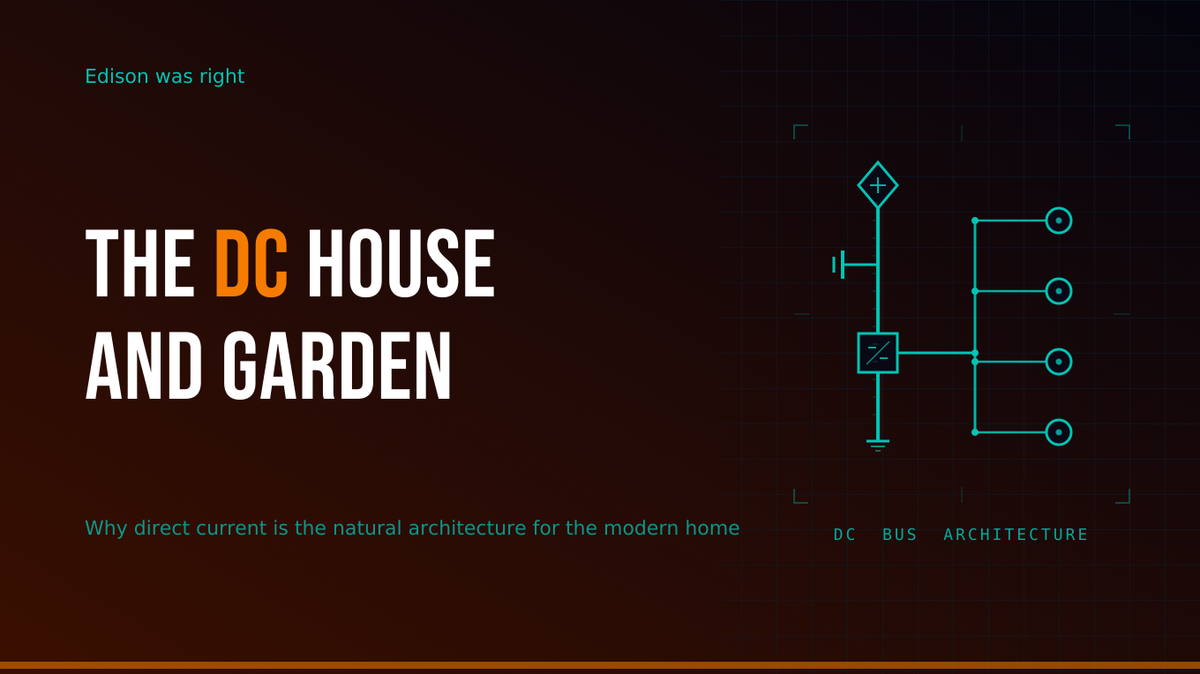
The AC grid made sense when power travelled from central plants to passive loads. Distributed solar, home batteries, and electric vehicles have changed all three of those conditions. A DC distribution architecture — from the landscaping cart to the living room to the international standard — is not a speculative future. It is the obvious next step, and most of the infrastructure to support it is already installed. Edison, it turns out, was right — just at the wrong scale, and a century early.
A small problem reveals a large pattern
The proximate cause of this article is leaf blowers.
Californians now subject to the state's ban on new sales of small off-road engines have had to make do without 2-stroke landscaping equipment. Battery alternatives have matured considerably: the Stihl, EGO, Milwaukee, and Makita battery platforms now deliver performance comparable to their petrol equivalents for most residential tasks. The problem is the professional landscaper running equipment for six or eight hours a day. Their energy requirements outrun what a sensible battery inventory can deliver, and the logistics of swapping and charging across a full working day are genuinely burdensome.
An observed workaround is coupling a conventional portable generator with corded electric tools. The characterisation as a workaround is deliberate: substituting a generator for a direct-drive 2-stroke engine exploits the letter of legislation whose spirit was cleaner air and quieter neighbourhoods, not the relocation of combustion to a slightly larger and marginally better-behaved machine positioned a few metres away. This is quieter than a 2-stroke, substantially cleaner in terms of exhaust and emissions, and it works. But it prompts a question worth pursuing: what would it look like to design this system deliberately, rather than bolting together off-the-shelf components whose interfaces were designed for completely different purposes?
The answer leads somewhere much larger than a landscaping cart.
The DC bus is the natural architecture for a jobsite
A petrol generator running corded electric tools wastes energy at every step. A conventional generator runs its engine at a fixed speed to hold AC frequency; an inverter generator varies its speed but does so by rectifying to DC internally and then inverting to AC at the outlet. Either way, the tool's motor controller immediately rectifies that AC straight back to DC. The AC generation, distribution, and re-conversion are all overhead that serves no purpose except compatibility with a grid that is not present on the jobsite.
A better design starts from what the tools actually want and works backwards. Modern brushless power tools run on direct current — typically in the 40 to 80 volt range. A purpose-built system skips the AC stage entirely: a small engine drives a permanent-magnet alternator whose output is rectified to a DC bus. Tools connect to that bus via a cable, with a small DC-DC converter at the tool end stepping down to the working voltage.
The element that makes this architecture elegant is the buffer battery. Sitting on the DC bus, it absorbs transient load spikes — the surge when a blower hits a dense pile of wet leaves, the kick when a saw bogs in hardwood. The engine no longer has to track instantaneous demand; it runs at a single constant speed chosen for efficiency, noise, and emissions. The battery covers the gap between average load and momentary peak. This is the serial-hybrid architecture that has powered diesel-electric locomotives for the better part of a century, scaled to fit on a wheeled garden cart.
The choice of bus voltage for the trunk — the cable running from the cart to wherever the crew is working — determines everything about cable weight and practical reach. Low bus voltage means high current; high current means resistive losses that scale with the square of the current; resistive losses mean either heavy cable or very short runs. A 2 kW blower at 48 V draws 42 A. Running that load fifty metres requires welding-grade cable and loses a meaningful fraction of the supply voltage before it reaches the tool.
The trunk voltage wants to be as high as practical while staying within reach of standard components and safety regimes. Two hundred and forty volts might come to mind first — it is, after all, the supply voltage most people in the US encounter at their range or dryer outlet. Data centres and commercial building microgrids have converged on 380 V, for good reasons: it sits below the 600 V threshold that triggers more demanding industrial safety standards and matches the natural output of solar arrays and battery systems at residential and commercial scale. For reasons that will become clear in a moment, 400 V is the better choice for this architecture. At 400 V DC, that same 2 kW load draws just 5 A. In principle, a standard 12 AWG extension cord — available at any hardware store — would handle that more than adequately. At 5 A, a 100-metre cable incurs a voltage drop of under 2% and negligible heating.
In practice, the cable needs to meet a higher specification than a domestic extension lead: double insulation rated for 600 V or 1000 V DC, a robust outer jacket resistant to abrasion, UV, and foot traffic, and connection only through interlocked DC-rated connectors that de-energise before separation. The safety concern at this voltage is not shock from an intact cable — the insulation provides complete protection, as it does on any mains extension cord — but the behaviour of a damaged one. DC at 400 V does not self-extinguish at zero crossings the way AC does, so a cable cut by a mower blade or vehicle produces a sustained arc rather than one that naturally goes out. The mitigation is ultra-fast ground-fault detection at the source, which de-energises the cable in milliseconds — the same technology used in EV fast chargers, where identical fault conditions exist and an excellent safety record has been established. The cable itself is therefore unremarkable; the source-side protection is not optional.
The cable weighs probably less than 4 kg for a 100-metre run and is easily managed by one person. The high-voltage trunk then steps down at satellite distribution hubs positioned near the work, delivering 54 V — the highest nominal voltage whose peaks stay below the 60 V threshold that triggers more demanding safety certification — to short tool cords.
The EV truck renders the dedicated generator transitional
A Ford F-150 Lightning, Rivian R1T, Silverado EV, or Cybertruck parked at the kerb carries 130 to 200 kWh of battery. The crew's daily energy requirement for all tools across a full day is perhaps 5 to 10 kWh. The truck is already there. The energy is already onboard.
Every V2L-capable EV truck offers 240 V AC outlets at 7 to 10 kW. This alone is enough to run several corded tools from the truck bed with no separate generator. The conversion losses through the V2L path — battery DC inverted to AC, then rectified back to DC inside the tool — are real but inconsequential relative to the available energy. At current US electricity prices, a full day's tool energy drawn from the truck battery costs a dollar or two.
The more architecturally coherent option is coupling the truck's high-voltage DC battery directly to the distribution cart via its fast-charge port running in reverse. Modern bidirectional EV charging uses CCS or NACS connectors carrying DC at 400 V or 800 V. Four hundred volts is the architecture's natural choice for exactly this reason: it is the nominal battery voltage of most current EVs and the voltage their bidirectional charging ports operate at. Aligning the jobsite bus with the truck's native voltage eliminates a conversion stage at the point of connection. The gap between 380 V and 400 V is also worth dismissing: the two are effectively the same voltage class, real systems operate across a range, and the practical difference is negligible. The choice of 400 V simply ensures the architecture and the truck speak the same language. The cart presents itself as a load, the truck delivers DC, and the cart's DC-DC converter steps down for tool use. No intermediate AC conversion. No engine. The cart shrinks to a converter, a small buffer battery, and outlets — perhaps 15 kg total, on wheels.
At 400 V DC, the cable physics present no obstacle. A 3 kW load draws 7.5 A. Over 100 metres of standard 12 AWG wire the round-trip voltage drop is under 2% and the cable dissipates less than 60 W — comfortably within the cable's continuous rating. A cable that was impractical at low voltage becomes entirely routine at high voltage. The truck can sit at the road while the crew works 100 metres into a property, connected by a cord barely heavier than a standard mains extension lead.
There may be some scenarios where a generator is still required. These will generally be where the site is genuinely inaccessible to vehicles, or where the energy requirement exceeds what the truck battery can spare.
The architecture has particular merit in forestry and wildland applications, where the case for eliminating small fossil-fuel devices goes beyond noise and emissions. Two-stroke equipment is a documented ignition source for wildland fires: hot exhaust contacting dry fuel, fuel spills during refuelling, and spark arrest failures have all contributed to fire starts in fire-prone regions. California, Australia, and parts of southern Europe have at various times restricted or prohibited petrol-powered equipment during fire season for exactly this reason. A DC-powered chainsaw or brush cutter fed from a platform generator or vehicle has none of these failure modes — no hot exhaust near ground-level fuel, no refuelling on site, no carburettor flooding. In remote forestry where the vehicle cannot follow the crew to the working face, the generator platform itself can be designed around a fuel cell or a larger battery, both of which eliminate the ignition risks entirely. The safety argument in this context is not incidental; it is the primary one.
As fleet electrification advances, the cases requiring a dedicated generator become the minority. The architecture accepts the generator and the truck interchangeably, because the DC bus voltage is the same either way.
The same logic applies indoors
A pattern is now visible. The landscaping problem was: distributed loads want DC, available power sources produce or distribute AC, and energy is wasted at every conversion boundary. The architecture that solves it — high-voltage trunk, buffer storage, local stepped-down distribution for actual loads — is not specific to landscaping.
It is the architecture that residential buildings ought to have.
A rooftop solar installation produces DC. The home battery stores DC. The electric vehicle charges on DC. LED lighting operates on DC. Every device with a switch-mode power supply — laptops, televisions, routers, kitchen appliances with electronic controls, the variable-speed motors in heat pumps and washing machines — converts incoming AC to DC immediately upon receiving it. The AC wiring throughout the house is, at this point, a compatibility layer for a world that no longer exists: centralised generation, passive resistive loads, no local storage.
The author proposed a version of this to a group of technical colleagues some years ago following frustration rewiring a light switch — a DC distribution layer for lighting and small appliances, using USB-C as a natural starting point for personal electronics, augmented by a higher-power DC tier for appliances that exceed USB-C's current ceiling. The reception was muted. The case has grown considerably stronger since, as solar, battery, and EV adoption have each added another source or load that is natively DC and incurs avoidable losses at every AC conversion boundary.
240 V AC is the pragmatically correct trunk for the US residential market
The natural extension of the jobsite's 400 V DC trunk to the residential context runs into a practical objection from anyone familiar with the US construction industry. Residential high-voltage DC — whether 380 or 400 V — is not a recognised voltage class in the National Electrical Code, has no established UL pathway, and would draw engineering sign-off and variance procedures from any inspector who encountered it. The engineering is sound; the regulatory friction is fatal.
The 240 V AC infrastructure already present in every home with an electric range, dryer, or central air conditioner sidesteps all of it. The trunk stays as it is; the hub takes 240 V AC in and delivers 48 V DC out to the branches. Installation becomes analogous to fitting an EV charger outlet: an afternoon's work for any licensed electrician, no panel upgrade in most cases, nothing to surprise an inspector. The hub is the boundary — familiar AC upstream, and downstream of it, voltages low enough to carry dramatically relaxed regulatory requirements.
This matters most for the existing housing stock. A new build could in principle be wired to any standard its designers chose, and if the whole world were being built fresh, an engineered DC trunk might well be the answer. But the whole world is not being built fresh: there are roughly 140 million existing housing units in the US alone, and the ones that matter for adoption are the ones already standing. A standard that requires them to be rewired from the service entrance is a standard that will not be adopted. A standard that runs on the 240 V AC they already have, and layers DC on top of it incrementally, is one a homeowner can actually begin. The pragmatic trunk choice is therefore not a compromise imposed by regulation; it is the thing that makes the transition possible at all.
Class 2 is the regulatory unlock, and it defines the outlet tiers
NEC Article 725 classifies circuits below specific power and voltage thresholds as Class 2 — essentially harmless from a shock and fire perspective, subject to correspondingly relaxed installation rules. Class 2 wiring does not require conduit, does not carry the same fire-stopping obligations as line-voltage work, does not require a licensed electrician in many jurisdictions, and in many cases does not require a permit at all. It is treated, roughly, like network cable. A 48 V DC branch limited to 2 A comes in just under the 100 VA Class 2 ceiling — and that single fact is what moves residential DC out of the domain of major electrical work and into the domain of something a competent homeowner can extend without a licence.
The threshold also shapes the outlet scheme. A complete residential design presents at least three distinct outlet types, matched to the load. Forty-eight volts DC serves lighting, personal electronics, and the growing population of small appliances whose motors and controls are already DC internally — with USB-C as the connector for anything within its 240 W ceiling, and a heavier low-voltage DC outlet for stick vacuums, blenders, laptops, and the like. The 240 V AC that the trunk already carries stays available at conventional outlets for the loads that genuinely want it. A kettle drawing 3 kW would pull 62 A at 48 V — an absurd current demanding welding cable — but only 12.5 A at 240 V, which is why kettles, toasters, ovens, and space heaters are best left on the AC tier. The design principle is to match each load to the lowest voltage that serves it without forcing impractical currents, leaving the high-power resistive loads on the AC they were always suited to. The house ends up with a small number of AC outlets for a shrinking set of legacy and high-power appliances, and a proliferation of low-voltage DC outlets — most of them Class 2, most of them installable without a licence — for everything else.
Smart switching falls out of the architecture naturally. The switch carries no power; it sends a control signal to the hub, which switches the load via solid-state relays. This sidesteps the DC arc-interruption problem that makes direct DC switching more demanding than AC. It also makes multi-way switching — the three-way and four-way arrangements that govern stairwells, long hallways, and large rooms — trivial to extend or modify: any switch can control any load, the traveller-wire topology disappears from the design, and adding a further switch position requires only a signal connection rather than a restructured power circuit.
The retrofit can be done in stages, starting with lighting
The instinctive objection to any of this is that it means rewiring the house. It does not. The transition can be made one circuit at a time, over years, and the first stage is the one most people would want anyway.
The reason it can be staged is that the copper already in the walls can carry DC without modification. A 14 AWG solid copper conductor rated at 600 V insulation, installed to carry 15 A of AC, does not change when it carries 2 A of DC at 48 V. The conductor is indifferent to current direction and entirely comfortable at a fraction of its rated current. The insulation rating exceeds the new working voltage by more than an order of magnitude. The existing cable can be re-energised at 48 V DC without replacement, splicing, or opening a single wall.
Lighting is the natural place to begin. It is low-power, low-risk, physically separable from the rest of the house's wiring, and — with the LED transition already complete in most homes — running on DC internally regardless. Converting a house's lighting means installing one small hub per floor, fed from the 240 V AC trunk, each distributing to fixtures over several lightly-loaded branches; for a typical two-storey house, two hubs cover the entire lighting load. Because each branch carries only an ampere or two over a short run to nearby rooms, the reused cable is working far below its rated current, and even 18 AWG would be ample for any new runs. The work happens at just two points: the hub where the lighting circuits meet the panel, and a driver swap at each fixture, a task no more demanding than changing a bulb. The wiring between is reused in place. Even the three-core cable serving three-way switch arrangements carries over — the traveller conductors that once switched AC line voltage become low-voltage signal wires to the hub, and power no longer passes through the switch at all.
The scope of a lighting conversion is therefore bounded and predictable: an electrician's afternoon for the hubs, driver replacements at the fixtures, and controllers replacing the old switches — which, since they no longer carry load current, become simple signalling devices whose existing wiring is reused. No wall opening, and no new cable runs in the general case.
The strategic value of doing lighting first is that it establishes the hub, the DC bus, and the household's familiarity with the system. Once that infrastructure exists, subsequent stages fall within reach of the homeowner. Adding a run of DC outlets for lighting-adjacent loads, extending the low-voltage network to a home office, wiring in USB-C outlets — these are Class 2 tasks that in most jurisdictions require no licence and no permit, comparable in difficulty to running speaker wire or setting up a home network. The person who would never open their breaker panel will happily install low-voltage DC, because it is the kind of work they already do. The lighting conversion is not merely the easiest first step; it is the step that hands the rest of the project to the homeowner.
The cost of getting there depends on the house. Where the existing lighting wiring is sound and can be re-energised in place, the conversion buys no new cable at all — the expense is the hubs, the fixture drivers, and the switch controllers, plus an afternoon of an electrician's time. Where wiring does have to be run — an old house being rewired anyway, or new circuits added — the DC approach is cheaper on both counts that matter. The cable is thinner and less of it: the low-voltage branches carry so little power that light, flexible conductor suffices in place of stiff solid-core mains cable, and one hub feed replaces several individual circuit runs back to the panel. And a substantial share of the work drops below the licensed-electrician threshold, shifting hours from skilled to semi-skilled labour or to the homeowner. Both savings compound in a new build, where nothing is being reused and everything is being installed from scratch.
The cost case is strongest where solar is already involved
The new-build case is where those two savings — less copper, less skilled labour — combine with a third, and it is worth working through in numbers.
Materials savings in the wiring itself are real but modest — perhaps $500 to $1,500 from reduced copper in lighting circuits and simplified panel layouts. The more substantial saving is in solar and battery integration, which is increasingly standard in new US construction. A DC-native system eliminates the solar inverter (replaced by a simpler MPPT charge controller) and the battery inverter (replaced by a DC-DC converter), and avoids the panel upgrade that solar installations frequently trigger. These items represent $3,000 to $8,000 in a typical residential solar installation. Even capturing half that saving, the DC architecture delivers $2,000 to $5,000 less in installed system cost before accounting for labour.
Labour savings are comparable in magnitude. Low-voltage DC wiring installs faster than line-voltage AC: the cable is flexible, hub terminations are simpler than individually back-wiring outlets and switches with stiff solid copper, and a portion of the work falls below the licensed-electrician threshold. A full new build with solar and DC distribution might save $2,000 to $4,000 in electrical labour relative to the conventional equivalent.
The combined upfront saving for a new build with solar: $4,000 to $12,000 from day one. This is not a payback argument. The DC architecture is cheaper upfront. The technically superior choice is also the financially obvious one.
Retrofit economics are less dramatic but real. A lighting retrofit — two hubs, driver replacements, switch controller upgrades — costs $1,200 to $3,500 in materials and labour, and delivers $60 to $220 per year in direct electricity savings. The simple payback period on electricity savings alone is long. But the electricity saving understates the value: smart lighting control — scene management, scheduling, occupancy sensing — comes essentially free with hub installation and would otherwise require $200 to $500 per room in standalone smart-home hardware. The retrofit makes most sense when renovation or lighting replacement is happening anyway, not as a standalone energy investment.
As the appliance ecosystem matures, ongoing savings accumulate on every device purchase. The internal power supply in a small appliance or consumer electronic device represents 15 to 30% of its manufacturing cost. In a competitive market, DC-native appliances — requiring no internal conversion — will be cheaper. They should also be more durable, since the internal power supply is frequently the component that fails first in AC appliances, degrading under thermal cycling until capacitors weaken and regulation drifts. Removing the internal supply removes the primary failure mode.
This architecture dissolves the international voltage fragmentation problem
AC grid voltages differ across countries for reasons that have nothing to do with what is optimal for the equipment using the power. North America uses 120 V/60 Hz with 240 V available for heavy loads. Europe and most of Asia use 230 V/50 Hz. Japan uses 100 V at both frequencies depending on region. These are historical accidents compounded by decades of infrastructure investment, and they impose real costs: dual-voltage appliance designs, traveller adapters, constrained global product markets, and the continuing engineering overhead of designing equipment to operate correctly across all these permutations.
A DC distribution standard carries no frequency, eliminating the 50 Hz/60 Hz incompatibility entirely. The remaining question — which DC voltage — can be answered on engineering grounds rather than historical accident. Forty-eight volts for low-power distribution and lighting; a high-voltage tier in the 380 to 400 V band for trunk distribution and major appliances, aligned with the commercial-building convergence at the lower end and EV charging at the upper. Neither has national incumbency. A standard adopted globally from the outset could achieve genuine universality in a way the AC grid never could.
This is not a remote prospect. The USB-C Power Delivery specification — effectively a global DC standard for personal devices up to 240 W — has achieved near-universal adoption. The European Commission's Common Charger Directive has demonstrated that international DC standardisation is politically achievable: USB-C is now mandatory across the EU for portable device charging, with the mandate extended to laptops as of April 2026 — a regulatory intervention that has compressed the standardisation timeline substantially. The IEC is actively working on low-voltage DC distribution standards. Several existing platforms — EMerge Alliance, Current/OS Foundation in Europe, various national pilot programmes — are building towards commercial and residential DC standards.
The window for establishing a genuinely universal residential DC standard — one that doesn't repeat the AC fragmentation — is open and probably not permanent. It closes as national implementations calcify around local variants.
The global efficiency dividend is real, if bounded
Everything to this point has been local. A quieter jobsite; a homeowner converting their lighting one weekend; a slightly cheaper new build. The motivation throughout has been immediate and practical — better tools, easier wiring, lower bills. But when the same small change is made across enough houses, the sums stop being local. The energy no longer wasted in a hundred million redundant conversions, and the copper no longer mined to wire a hundred million homes at unnecessarily low voltage, add up to quantities that register at national and global scale. That the pursuit of a better jobsite and a tidier fuse box should end in a measurable contribution to energy and materials consumption is a surprising outcome, probably an unintended one, and certainly a welcome one.
Working through the numbers honestly: residential electricity is roughly a quarter of global consumption, and consumption is rising as heating and transport electrify. A DC-native residential sector saves in the range of 5 to 10% of the electricity it handles, from eliminated conversion stages and reduced standby losses. At moderate global penetration — 40 to 50% of residential consumption by mid-century — the saving lands somewhere between 250 and 500 TWh per year, with the exact figure depending heavily on adoption rate and the extent of solar and battery integration. This is comparable in scale to the savings already delivered by the global LED lighting transition. It is a meaningful contribution, not a civilisation-scale intervention on its own.
The materials savings may matter more than the energy savings in the near term. A DC-native home uses less copper than its AC equivalent, from three distinct sources. High-power distribution runs at the highest practical voltage — the existing 240 V service, rather than splitting heavy loads across 120 V circuits — and copper cross-section for a given power and voltage-drop budget falls with the square of the voltage, so keeping the high-power tier at high voltage is where the largest wiring saving sits. The low-voltage DC branches serving lighting and small devices carry so little absolute power — a handful of watts per LED — that they run on thin conductor regardless of voltage. And eliminating the switch-mode power supply inside hundreds of millions of appliances removes the copper wound into each one. Taken together these are a substantial reduction in residential copper intensity. Global copper demand is growing rapidly with electrification; anything that trims marginal demand has leverage on constrained supply chains and on the environmental cost of mining.
The indirect effects may be the largest contribution of all. DC-native homes integrate solar and batteries more efficiently, making those systems more economic at a given installed capacity, which drives higher penetration, which displaces more fossil generation. The cascade is genuine even where it resists precise quantification. An architecture that is 10% more efficient in combination with a 20 kWh home battery and 10 kW of solar delivers more absolute saving than 10% more efficiency on a grid-only house.
DC distribution is a second-order climate contributor — real, durable, and compound in its effects, but dependent on the primary transitions (renewable generation, electrified transport, building electrification) for much of its impact. It is most valuable as an enabler of those transitions, not as a standalone solution.
The US residential market is a specific, underserved gap
The DC building distribution space has a serious practitioner. Current/OS Foundation is a European nonprofit with 130 partners across 30 countries, published technical standards, and real deployed projects spanning data centres, commercial office buildings, EV charging infrastructure, industrial sites, and at least one DC-powered residential neighbourhood in the Netherlands. Their work is technically sound, their ecosystem is substantial, and their certification mark is already in use by major manufacturers.
Their focus, however, is on commercial and infrastructure applications in European regulatory contexts. The US residential retrofit market — the homeowner with existing wiring, a recent solar installation, and an EV in the garage — is not their primary constituency. Their technical standards are oriented toward professional electrical contractors working on new commercial construction, not toward the specific characteristics of US residential construction: the 120/240 V split-phase legacy, the solid copper NM-B wiring that makes every outlet box a small ordeal, the fragmented Authority Having Jurisdiction landscape across fifty states and thousands of local jurisdictions, and approximately 140 million existing housing units that will not be rebuilt from scratch.
The gap is specific and actionable: a US residential standard, built on the 240 V AC trunk that already exists in most homes, specifying a 48 V DC lighting and small-appliance layer using Class 2 wiring and largely reusable existing conductors, integrating USB-C for personal device charging, and providing explicit migration pathways for retrofit installation that neither require full rewiring nor depend on regulatory approvals that do not yet exist. The standard would reference and align with Current/OS where the two overlap, and address territory Current/OS is not presently covering.
The natural commercial structure for this is a standards organisation with revenue from certification of compliant products and installations — a model similar to Current/OS itself, but oriented toward the US residential market and structured to engage homebuilders, solar installers, electricians, and consumer appliance manufacturers rather than industrial contractors and commercial building owners.
Edison was right, and the timing is finally right
Thomas Edison argued for direct current distribution in the 1880s. He lost, for good reasons: at the voltages available in that era, DC could not be efficiently transformed for long-distance transmission, and AC could. The grid that Westinghouse and Tesla built was the correct engineering choice for its time.
Three specific things have changed at the residential scale. Generation is increasingly distributed and local — rooftop solar produces DC. Storage is increasingly present at the point of use — home batteries and EV batteries store DC. Loads are increasingly electronic rather than resistive or inductive — almost everything in a modern home converts incoming AC to DC immediately upon receiving it. The AC distribution layer that connects these sources and loads is now a compatibility shim for a world that has largely passed.
Edison was arguing at the wrong scale. The case for DC was never about transmission across miles; it was about distribution within a building. He was right about that, and the underlying reasons have only grown stronger as the building's electrical composition has shifted from motors and incandescent bulbs to electronics, variable-speed drives, and battery-connected devices.
The enabling infrastructure is already being installed for other reasons. Every EV charger is a bidirectional DC interface. Every home battery is a DC storage device. Every solar installation is a DC source. The cables, connectors, and control systems to connect these into a coherent DC distribution architecture are a modest incremental step from what many homes already contain.
The question is not whether residential DC distribution happens. The physics are too favourable, the economics too compelling, and the complementary infrastructure too far advanced for it not to. The question is whether it happens around a coherent, universal standard — one designed from the outset to avoid the historical accident of AC fragmentation — or around a proliferation of incompatible proprietary implementations that will take decades to reconcile.
Someone should write that standard. The technical case has been made.
This article was researched and drafted in collaboration with Claude (Anthropic), which served as research partner, technical interlocutor, and drafting collaborator. The analysis emerged from an extended conversation exploring the architecture from its origins in landscaping equipment through to residential distribution, international standardisation, and global implications. Claude is credited here as a substantive intellectual contributor to the work, not merely as a writing tool.
Thanks are due to Todd Bohaboy, whose intervention at what subsequently turned out to be the midpoint of the development of this article reshaped its second half. Where the discussion had been reaching for a 380 V DC trunk, Todd pointed out that such a voltage would be a non-starter in US homes on UL and code grounds, and insisted that retaining the existing 240 V AC service was the only practical way forward. His insight is the foundation of the residential architecture described here.