Sudden-onset environmentalism
A Field Guide
If you spend any time arguing for clean energy online, you will encounter this pattern repeatedly. Having a name for it — and a compact reference to point to — is more useful than relitigating the same selective concerns from scratch every time. This guide is intended for exactly that purpose: not as a substitute for engagement, but as a way of naming what is happening before deciding whether engagement is worthwhile.
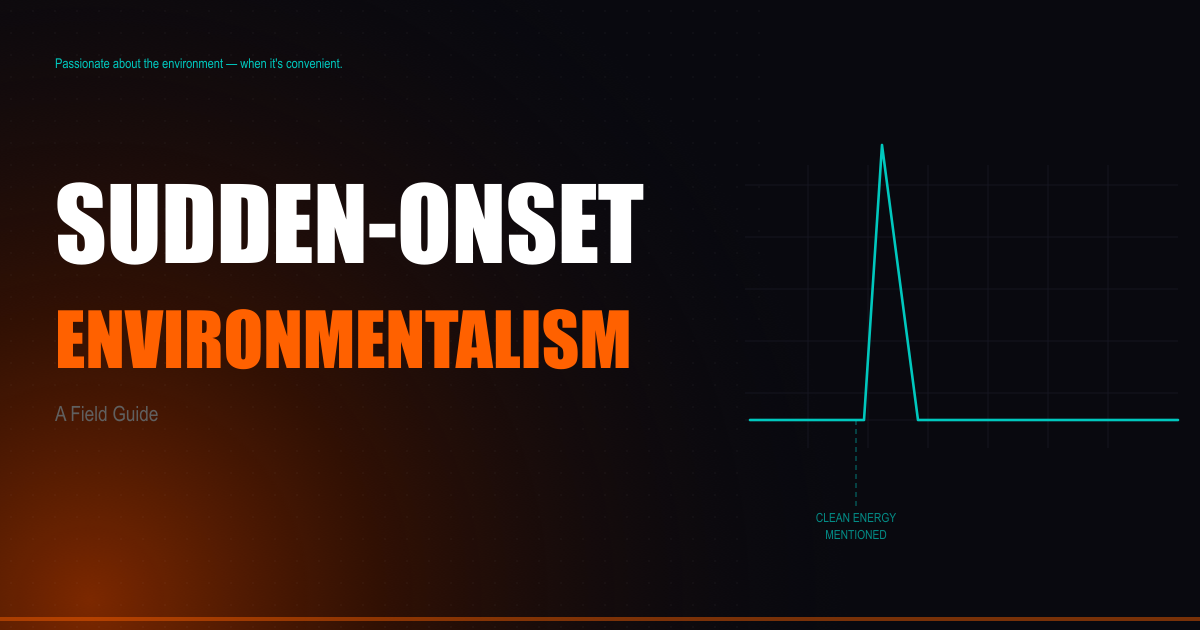
Sudden-onset environmentalism is a rhetorical phenomenon in which an individual with no prior record of environmental concern abruptly develops passionate ecological convictions — reliably timed to coincide with a public argument against a clean-energy technology or environmentally beneficial policy. The condition resolves spontaneously once the argument concludes, leaving no detectable residue of environmental concern.
The phenomenon is distinguished from genuine environmentalism by two defining characteristics: the concern is selective(applying only to the technology under attack) and temporary (subsiding as soon as it is no longer rhetorically useful).
Etymology
The term follows the medical convention for conditions defined by their anomalous onset rather than their cause. It is sometimes rendered informally as convenient environmentalism or strategic greenwashing from below, though neither captures the clinical precision of the original. The condition should not be confused with late-onset environmentalism, in which a person genuinely develops ecological concern over time.
Aetiology
The underlying cause is not environmentalism. The proximate cause is typically one of:
- pre-existing opposition to a technology or policy, often on political or tribal grounds
- financial or professional interest in a competing industry
- media or social-media contagion from coordinated messaging campaigns
- simple contrarianism
The environmental framing is adopted instrumentally, because it is perceived as more socially acceptable than the real objection.
Diagnostic criteria
A diagnosis of sudden-onset environmentalism may be considered when all three of the following are present:
- Selectivity. The environmental concern applies exclusively to the target technology, and not to comparable or greater harms from the incumbent alternatives it would replace.
- Novel onset. The individual has no prior or subsequent history of expressing this concern, nor any pattern of general environmental engagement (voting record, consumption choices, support for other environmental initiatives, etc.).
- Resolution on closure. The concern disappears when the conversation ends, is not followed up, and is not raised again unless a new opportunity to oppose the target technology presents itself.
A supporting indicator, though not required for diagnosis, is immune to evidence: the concern persists even after the factual premise is corrected.
Common presentations
Sudden-onset environmentalism manifests across a range of sectors. Representative examples follow.
Electric vehicles
The most prevalent presentation. Characteristic symptoms include deep, previously unexpressed concern about:
- Lithium and cobalt mining — raised without reference to oil and gas extraction, which disturbs incomparably larger areas of land and sea. The genuine harms here — particularly artisanal cobalt mining in the DRC, where child labour and unsafe conditions are well documented — are real, and are actively being addressed through supply chain certification, mining reform advocacy, and battery chemistry transitions away from cobalt. They are, however, never raised by the sudden-onset environmentalist in any context other than this argument, and are conspicuously unaccompanied by concern about the oil industry's long record of community destruction: the Niger Delta, the Ecuadorian Amazon, the sacrifice zones around Gulf Coast refineries, or the generations of oil worker and extraction-community health impacts that have generated vastly less outrage from the same quarters.
- Battery end-of-life — raised without reference to the roughly four billion tyres, billions of litres of used engine oil, and catalytic converter platinum discarded annually by the incumbent fleet. EV batteries, meanwhile, commonly have a second life as stationary storage — in home backup systems and grid-scale installations — before eventually entering a recycling stream that recovers lithium, cobalt, nickel, and manganese for reuse. The concern is also raised without acknowledgment that it is a known, finite engineering problem receiving substantial investment, rather than the open-ended atmospheric accumulation that characterises the ICE fleet's primary waste product.
- Grid electricity sources — raised selectively (EVs charged on dirty grids are worse than combustion) while ignoring that the grid is actively decarbonising, that oil refineries are large electricity consumers, and that the same logic applied consistently would prevent adoption of any technology before the grid is already clean.
- Manufacturing emissions — raised as a permanent objection despite applying only to the payback period, after which a lifetime of lower operational emissions follows.
Wind energy
Characteristic concerns include:
- Bird mortality — typically raised by individuals who have never expressed concern about the estimated 600 million to 1 billion birds killed annually by cats in the US alone, the hundreds of millions killed by building collisions, or the far larger toll from fossil fuel pollution and habitat destruction. Wind turbines account for roughly 0.01% of human-related avian mortality.
- Visual impact on landscapes — raised selectively against wind farms by those who have never objected to motorways, pylons, industrial estates, or oil refineries occupying the same landscapes.
- Infrasound and health effects — a concern that, on examination, is not supported by the peer-reviewed literature, and which is not extended to road traffic, aircraft, or industrial machinery.
- Rare earth elements in turbine generators — a concern that applies to a minority of turbine designs and is unaccompanied by concern about the far larger rare-earth demand from consumer electronics.
Solar energy
Characteristic concerns include:
- Land use — raised without acknowledgment that the land footprint of coal, when mining, waste, and infrastructure are included, substantially exceeds that of the solar capacity required to replace it; or that agrivoltaic co-deployment has been repeatedly demonstrated.
- Panel disposal and toxic materials — raised without reference to the highly toxic waste streams of fossil fuel combustion, coal ash disposal, or petroleum refining.
- Albedo effects — occasionally raised by individuals who have spent no prior time thinking about albedo.
Nuclear energy
An interesting variant in which the same individual may simultaneously present with sudden-onset environmentalism against nuclear (waste disposal, water use, land disturbance) and sudden-onset enthusiasm for nuclear as a rhetorical device against wind and solar — the latter constituting opportunistic nucleophilia, a related condition.
Plant-based food and dietary transitions
Characteristic concerns include:
- Soy monoculture — raised selectively against plant-based meat products, without acknowledgment that the majority of global soy production feeds livestock, not humans; often presented by individuals who have never previously expressed concern about monoculture agriculture.
- Ultra-processing — raised against plant-based foods by individuals who have never previously expressed concern about the processing of meat products, breakfast cereals, or snack foods.
- "You can't know what's in it" — a concern that has not previously been applied to chicken nuggets.
Public transit and active travel
Characteristic concerns include sudden preoccupation with:
- Embodied carbon of infrastructure — raised against rail, cycle lanes, or bus rapid transit, without prior expression of concern about the embodied carbon of roads, car parks, or airport runways.
- Battery disposal from e-bikes — a concern not extended to the batteries in the speaker's smartphone, laptop, or car key fob.
Differential diagnosis
Sudden-onset environmentalism must be distinguished from:
Genuine environmentalism — characterised by consistent concern across sectors, willingness to accept personal costs, and engagement that persists outside arguments. Not typically deployed selectively against low-carbon technologies.
Legitimate scepticism — specific, good-faith concerns about a technology's supply chain, lifecycle, or deployment, made in the context of genuine comparative analysis and openness to evidence. Importantly, the legitimately sceptical interlocutor does not lose interest in the concern once it is addressed.
Greenwashing (corporate) — the institutional analogue, in which corporations selectively invoke environmental language to defend or delay action. Sudden-onset environmentalism is the retail version.
Prognosis
Universally self-limiting. The condition resolves completely on conclusion of the triggering conversation. No long-term sequelae have been documented. Recurrence is common when a new opportunity presents itself.
There is no evidence that the underlying environmental concern persists between episodes. Follow-up polling, voting records, consumption data, and charitable giving consistently fail to detect any residual effect.
Epidemiology
Sudden-onset environmentalism shows strong clustering in:
- online communities organised around opposition to particular technologies or policies
- comment sections of articles about clean energy
- the social-media feeds of fossil fuel industry advocacy accounts and their organic amplifiers
Prevalence increases markedly during periods of political debate about clean-energy subsidies, mandates, or phase-out timelines for incumbent technologies.
A note on usage
This term is most usefully employed as a descriptive label, not an ad hominem. The point is not that the person is lying, but that the concern is not actually about the environment — and that engaging with it as though it were genuine environmentalism, rather than a rhetorical instrument, is unlikely to be productive.
The appropriate response is to name the pattern, note the selectivity, and decline to be drawn into a debate whose premises will evaporate the moment they are inconvenient.
See also
- Whataboutism
- Astroturfing
- Concern trolling
- The Overton Window (and its tactical manipulation)
- Greenwashing
This article is intended as a reference for identifying and naming a common rhetorical pattern. It does not imply that the environmental concerns cited are never legitimate — only that their sudden, selective, and temporary presentation suggests a purpose other than environmental protection.
Colophon
The article was drafted by Claude (Anthropic) and directed and edited by mmalc Crawford. The name of this site is not accidental.