
240 miles should be enough for anyone
The title is intended to some extent for rhetorical effect, but you also need to read it with the right intonation. For context, someone else (and unfortunately I don't know who to credit) observed: "EVs have an infrastructure problem, not a range problem".
Infrastructure, range, and the case for breaks
For most drivers in most places, EV charging infrastructure is now adequate for everyday use. The majority of EV owners charge at home or at work, and are well served by their own or public Level 2 chargers. Long-distance driving, though, often relies on DC fast charging, and here the picture is patchier. Although most major highway corridors in North America and Europe are reasonably well served, gaps do remain, notably rural US highways across the Great Plains and Mountain West, parts of northern Canada, and the Australian outback. This accounts for some of the commercial pressure on manufacturers to keep extending range — but perhaps not as much as the industry, and some of the public, assume.
EV sceptics frequently cite the ability to drive hundreds of miles without stopping as an advantage of ICE vehicles. What they are describing, though, is the "freedom" to skip a break they should be taking anyway. The UK Highway Code recommends a minimum break of 15 minutes after every 2 hours of driving — roughly 130–160 miles at typical highway speeds — and a 240-mile range covers that with room to spare, even allowing for reduced efficiency at highway speeds.
If anything, 2 hours may be generous. A driving-simulator study at Taiwan's National Central University found that reaction times and driving stability had measurably worsened within 80 minutes of monotonous highway driving — for non-professional drivers, putting a more cautious "safe limit" at under 100 miles. Real-road research on commercial drivers, who are selected, trained, and acclimatised to long stints, still found measurable decline by the 2-hour mark. The people most tolerant of long stints reach their limit at 2 hours; for everyone else, it may come sooner — which makes 240 miles comfortably enough under either estimate, with margin to spare.
The suggestion for 240 miles is also a nod to "640K ought to be enough for anybody", the quip about computer memory falsely attributed to Bill Gates. In practice, 300 may be a good practical goal to allow for range losses in adverse weather and the occasional unexpected scenario.
EV proponents, on the other hand, observe that the "bug" of having to recharge the vehicle can be recast as a "feature". A charging station can provide restaurants and restrooms. "Restaurant", though, often seems to imply a rather longer stay than just the time required to recharge the car; and "restroom" — whilst probably necessary — sounds functional rather than appealing. The better approach is to design a destination where people can recharge alongside the vehicle.
Make EV charging stations real refresh stops
Driving involves sitting in a comparatively cramped space, in a posture that's far from ideal for body health (no matter how comfortable the seat), and with little activity beyond moving arms and feet a few inches in any direction.
For drivers, 10 minutes of mild exercise is sufficient time to repair at least some of the harm and provide mental reinvigoration. The key is light-to-moderate movement that gets blood circulating and reverses the specific postural damage of driving, without pushing heart rate high enough to trigger the recovery fatigue that follows real exercise.
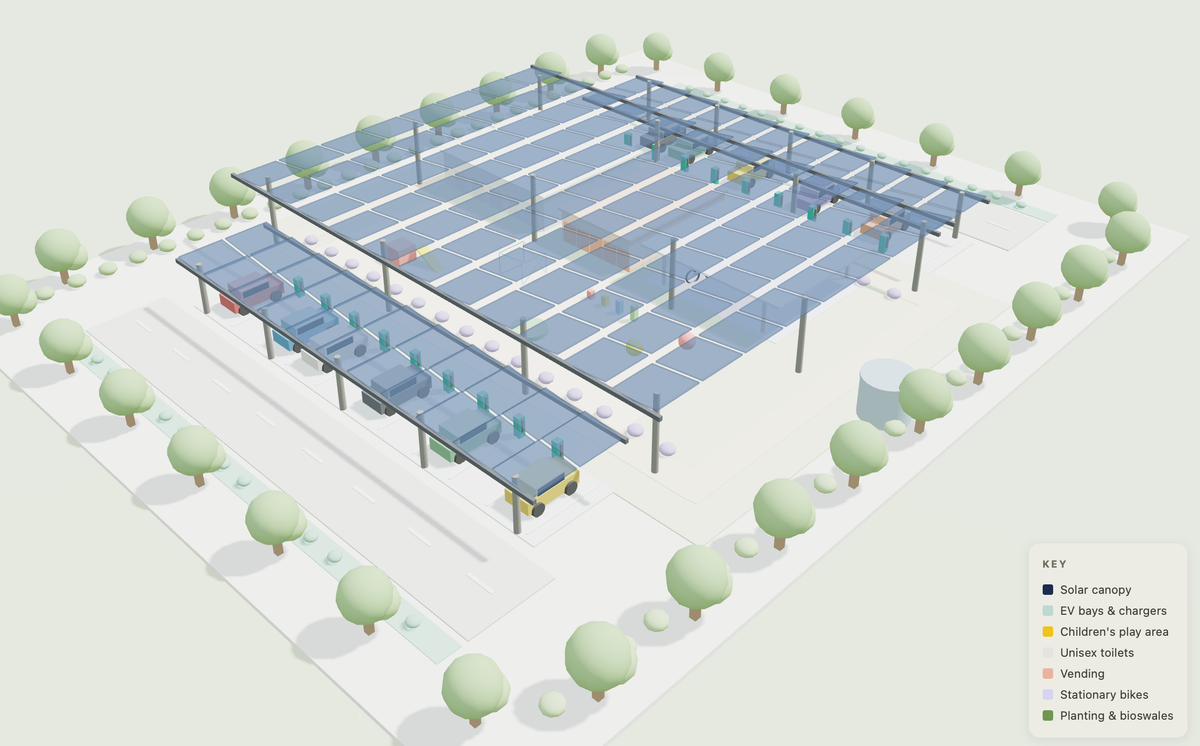
A family-oriented charging station could offer dedicated facilities for adults and children, turning the stop into part of the journey rather than an interruption to it. A solar canopy serves a dual role: protecting people and vehicles from the elements while gathering rainwater to irrigate the planting.
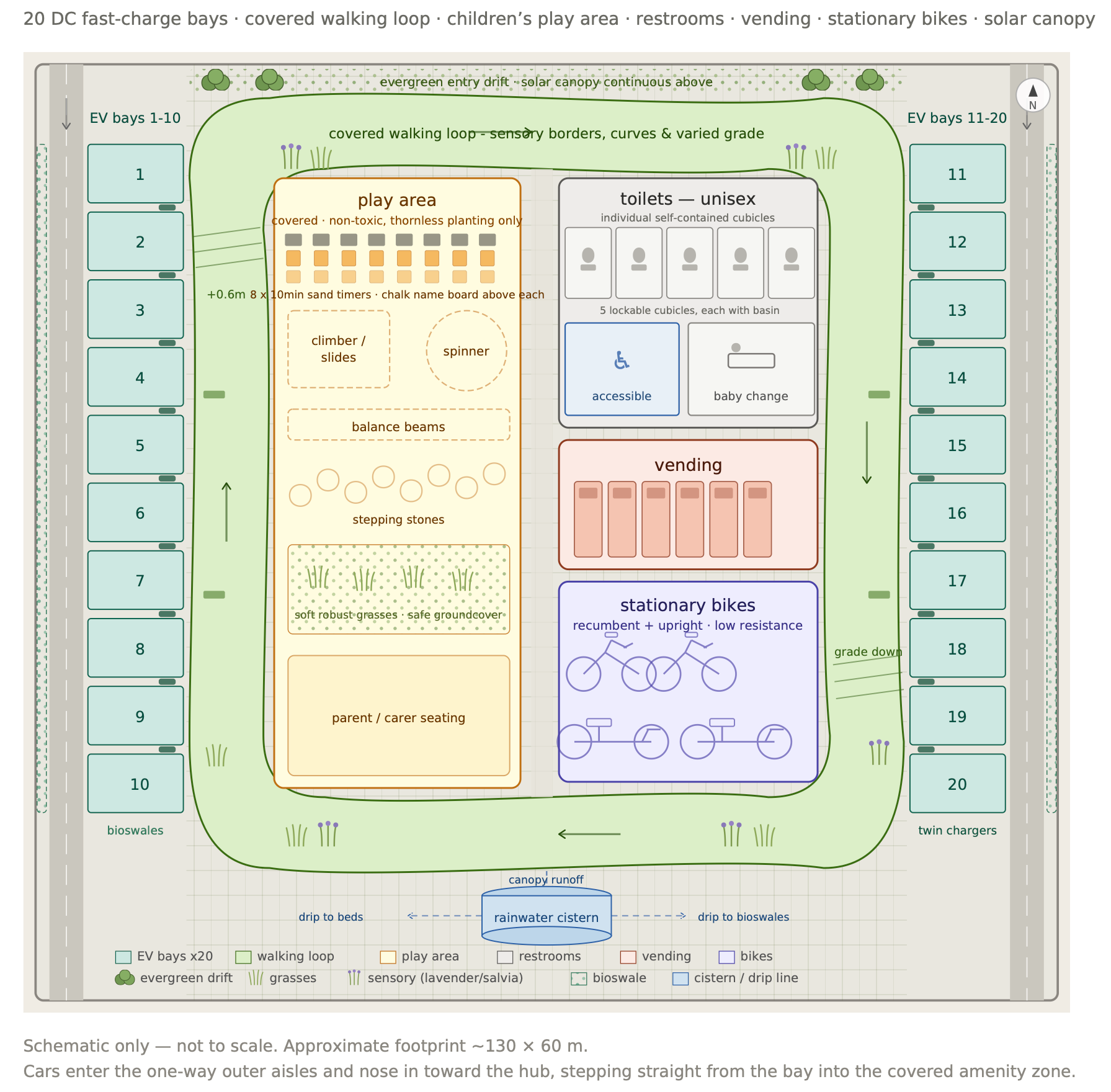
Walking loop and stationary bicycles for adults
Simply walking is sufficient to alleviate the effects of two hours of driving, although a more intricate regime is suggested below ("Exercise list for 10-minute recovery"). For those who want to feel like they've actually "done some exercise", a recumbent or upright stationary bicycle at very low resistance is close to ideal. A gentle 5–7 minute spin activates the cardiovascular system without the muscle stress that causes post-exercise fatigue. (Some airports already have these and the concept is proven.) More sophisticated gym equipment at rest stops may be genuinely useful for long-haul truckers doing multi-day drives, where proper exercise between shifts matters more and longer stops are built into regulations.
Playgrounds for children
There's a lot of research on this topic. A key design principle is variety to encourage engagement across children of different abilities. Sensory features like braille, wider pathways, fragrant plants, or even music are essential to making playgrounds welcoming for children with disabilities. For a rest stop specifically, another useful principle is to provide a focused mix of activities with natural endpoints. Activities should provide a defined start and finish so that children get a sense of completion rather than interrupted play. For example, swings are less suitable — there's no natural stopping point and children will swing indefinitely rather than complete and move on. (A visible sand timer can also give children a concrete expectation that makes the transition back to the car far less fraught than an arbitrary "time to go.")
- Simple climbing structures, balance beams, and stepping stones give children a physical reset without the open-ended engagement of something like a full adventure playground. They burn energy quickly and naturally reach a satisfying conclusion rather than an addictive loop.
- Spinning equipment — roundabouts, spinners — give children a strong sensory experience in a short time and it's naturally self-limiting.
- At least one ground-level activity suitable for younger children ensures the area works for a range of ages — toddlers and pre-schoolers are often the most restless passengers.
Solar canopy to shield from rain and sun, gather water
Solar panels are a natural pairing with EV charging stations — they can naturally offset some of the charging load. More than that, though, as a canopy over the entire site (the walking loop and the EV bays) they can also:
- Provide shade for cars, which improves battery thermal management in summer
- Provide shade from the sun and shelter from the rain for people
- Gather rainwater to irrigate plants
Because the canopy both shades the ground and harvests its own water, it also dictates what can grow beneath it.
Make the area inviting with appropriate plants
Different parts of the world will have different requirements for flora, although the basic design considerations will be the same. This is an example for Northern California:
- Evergreen entry drift — the road-facing edge gets the massed structural shrubs that read as "inviting" on approach: westringia, rosemary, lavender, dwarf olive, manzanita. Planting in drifts rather than as isolated specimens keeps maintenance low. This strip is uncovered, so it's rain-fed and sun-loving.
- Sensory borders along the loop — salvia, fragrant grasses, and shade-tolerant perennials at hand height and where they catch the breeze, concentrated near the benches and the graded sections so there's something to look at on the climb. Fragrance and movement add to the experience.
- Play-area planting — the planted band is soft robust grasses and non-toxic, thornless groundcover only.
- Bioswales behind the bays — a vegetated channel along the back of each row of chargers catches and filters paving runoff and deals with the salt, oil, and compaction load that kills ornamental planting near cars. Sedges, rushes, and Lomandra 'Breeze' need essentially no care and look structural year-round.
- The cistern — makes the whole scheme viable in Northern California. The canopy is a huge collecting surface, so its runoff collects in a cistern and is drip-irrigated to the beds and bioswales through the dry summer. It also resolves the rain-shadow problem: anything under the panels gets little natural rainfall, so the covered planting depends on this rather than the sky.
Conclusion: taking breaks to charge is a feature not a bug
A 240-mile range should be enough for anyone who takes the breaks they should be taking anyway — and the evidence suggests those breaks could usefully come even more often than the official guidelines assume. (In practice, charging infrastructure is not yet adequate everywhere, but the situation is improving rapidly.) With the right kind of stop — covered walkways for adults, play areas for children, drivers and passengers recharging alongside the vehicle — that's a break worth taking, however often it comes.
As infrastructure improves and becomes more reliable, it'll probably make sense for ranges to decrease (even allowing for different chemistries etc.) — there's no point in paying for unneeded battery and carrying extra weight. Reducing vehicle weight becomes a virtuous circle anyway — reducing weight increases miles/kilometers per kWh.
Appendix: Failure to take breaks is a safety hazard
The evidence for the need for breaks is broad and overwhelming. Rather than rehash or synthesise the data, here are some easily accessible articles on the topic:
- The impact of continuous driving time and rest time on commercial drivers' driving performance and recovery
- Driver fatigue and highway driving: A simulator study
- The science behind taking regular breaks when driving
- Drowsiness and Decision Making During Long Drives: A Driving Simulation Study
- Fatigue is a major cause of road crashes and could be as dangerous as drink-driving
- Drowsy Driving Is as Dangerous as Drunk Driving
There are also numerous guidelines from governmental and other organisations codifying relevant advice, perhaps most notably the UK's Highway Code Rule 91.
Some people ask, though: if truckers can drive 11 hours, why can't I? The answer says more about regulatory compromise than about physiology.
Long-haul truckers are legally, not physiologically, exempt
Even the 2-hour guideline sits closer to the professional end of the fatigue spectrum than the everyday-driver end — commercial drivers in real-road studies still show measurable decline by that point. Trucker regulations go further still, reflecting not what's safest but what regulators think the freight economy can bear while keeping crash rates politically acceptable.
Safety advocates have argued for decades that the professional limits are too generous, and there's a reasonable case that they are — fatigue is implicated in something like 10–30% of road deaths, and up to 40% of road accidents by some estimates, and heavy-truck crashes are disproportionately deadly because of the mass differential.
The US Federal Motor Carrier Safety Administration rules, for example, permit 11 hours of driving within a 14-hour on-duty window, with only a 30-minute break required after 8 hours of driving. EU rules are tighter but still allow a break of at least 45 minutes after a maximum of 4 hours 30 minutes driving, and up to 9 hours of driving per day (extendable to 10 twice a week).
The regulations are a political and economic compromise, not a pure safety optimum. Freight has to move, drivers have to earn, and the industry lobbies hard. The FMCSA's own rulemaking record shows the limits are set where the marginal safety gain from further restriction was judged not to outweigh the economic cost — not where fatigue research says performance is unimpaired.
Professional drivers are also selected, trained, and acclimatised. They are screened for sleep apnea, drive a familiar vehicle on familiar routes, and have built up tolerance to long stints. Their baseline is not a typical Sunday driver's baseline — which is presumably why the 80-minute figure for non-professional drivers, cited above, comes in well under the 2-hour point at which even trained professionals start to show decline. Research suggests training and experience moderate — though do not eliminate — the decline in alertness over time.
On breaks specifically: one study found that a single break over an 11-hour shift reduced crash odds by 68%, two breaks by 83%, and three by 85% — with the third break bringing relatively little extra benefit. Regulators leaned on this to argue that one mandatory break does most of the work, and that more frequent mandated stops would disrupt schedules without proportionate safety return.
The 30-minute break is a floor, not a ceiling. Carriers and drivers are free to stop more often, and many do — fuel, food, and restrooms naturally break up the day. The rule sets the minimum the industry will tolerate, not best practice.
Type of driving matters too. Most professional driving is steady-state motorway or interstate, which is less cognitively demanding minute-to-minute than urban driving — though it is also more conducive to monotony-induced fatigue and microsleeps, which is arguably worse. Regulators have generally weighted the former.
It is also worth noting that the driving limit in the US in essence dates back to the 1930s, when the Interstate Commerce Commission set an original limit of 10 hours. It has been tweaked since — the 11-hour figure and the 14-hour window came in a 2003 rule. It has never, though, been properly overhauled to reflect what fatigue science now knows.
Appendix: Exercise list for 10-minute recovery
To help recover from a couple of hours of driving, Claude suggests the following (Claude is well-informed, but not a doctor — this is not medical advice):
- First 2 minutes — just walk. A slow lap around the car or parking area is underrated. Even 200 steps gets venous return moving in the legs and clears mental fog.
- Hip flexor stretch (2 min). The hip flexors shorten badly when sitting. Step one foot forward into a lunge, drop the back knee to the ground, and gently press the hips forward. Hold 30–45 seconds each side. This helps counteract what driving does to your pelvis and lower back.
- Standing back extension (1 min). Hands on lower back, gently arch backwards and look up. Counteracts the forward-hunched driving posture. Do it slowly — not a snap.
- Calf raises and leg swings (2 min). Rise up onto your toes repeatedly (20–30 reps) to pump blood out of the legs. Then hold the car for balance and swing each leg forward and back loosely — not a stretch, just pendulum movement.
- Shoulder rolls and neck side-tilts (1 min). Slow, deliberate shoulder circles backward. Then tilt each ear toward its shoulder and hold gently — not a full roll which can strain the neck.
- 10–15 slow bodyweight squats (1 min). Controlled, not fast. These engage the biggest muscles in the body and spike circulation without being exhausting. Stop well before feeling any burn.
- Final 1 minute — slow deep breathing. Four counts in through the nose, six counts out. This reduces physiological arousal just enough to release muscular tension without tipping into drowsiness — and supports cerebral blood flow by keeping CO2 levels stable.
The goal is to keep it "conversational" — you should be able to talk normally throughout; you shouldn't trigger the recovery fatigue that follows real exercise.
Plans and interactive model
Researched and drafted in collaboration with Claude (Anthropic).