Three weeks against REDHEAD
The Federal Aviation Administration has spent two and a half years telling West Sonoma County that returning to a wider, higher departure path out of Charles M. Schulz–Sonoma County Airport (STS) is not possible. For three weeks in July, without announcing it as such, the agency did exactly that. It just didn't do it for the residents who asked.
There's a lot of context to understand here, and it's useful to present it all up front.
First, some terminology: a Standard Instrument Departure, or SID, is a published route that fixes exactly which heading, altitude and turn a departing aircraft flies immediately after takeoff, so that air traffic controllers can predict where every aircraft will be without a controller needing to issue individual turn-by-turn instructions.
STS has flown two competing SIDs for its southbound traffic:
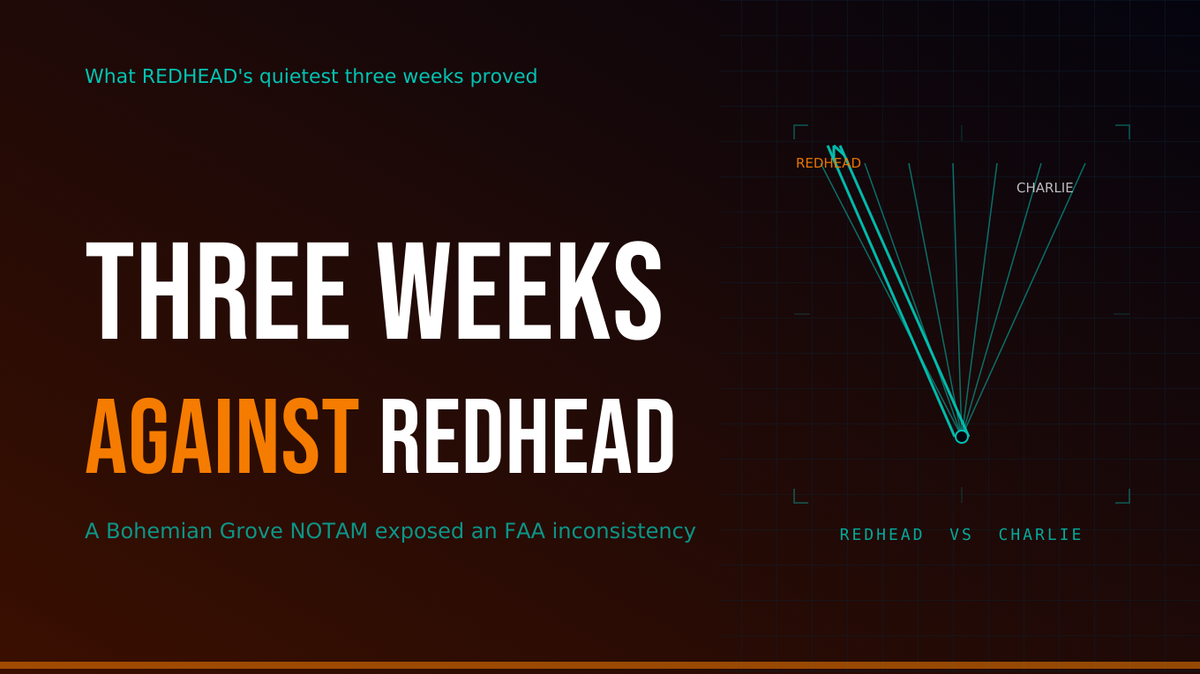
- CHRLY8 — CHARLIE — is the older, more flexible procedure: it lets controllers spread departures across a wider arc depending on real-time conditions, and for practical purposes it was the only departure procedure STS used for years.
- RREHD ONE — REDHEAD — is the newer one, adopted by the FAA in January 2024 as one of three new procedures quietly added to the airport's instrument-flight-procedure inventory that month, without notice to airport management or the public.
- Unlike CHARLIE, REDHEAD funnels nearly every southbound departure into a single narrow corridor west over West Sonoma County — directly affecting an estimate of at least 24,000 people across Sebastopol, Graton, Occidental, Forestville and neighboring communities — before turning south, concentrating noise that used to spread across a broader area onto the same homes, day after day.
The consequences of that switch are not abstract — and neither is the FAA's response to them:
- Airport noise complaints have gone from 1,135 in 2023 to 29,895 in 2025 to 32,581 through the first five months of 2026 — a volume county staff say now consumes roughly 1,800 staff hours a year, close to a full-time position, just to process.
- West Sonoma County residents have repeatedly asked the FAA to return to CHARLIE, at least until a permanent fix is studied.
- The agency's position — given in a written answer to a resident and obtained through a public records request — is that a permanent return to CHARLIE is not possible. It has said since 2024 that CHARLIE itself is not well suited to handling STS's present and future traffic. Separately, it has asserted that modifying a departure procedure requires studying its effects on other procedures, traffic flows, special-use airspace and neighboring communities, specifically so that noise is not simply shifted rather than reduced.
Finally, a NOTAM — notice to airmen — is the FAA's standard mechanism for flagging a temporary hazard, closure or operational change to pilots and controllers, typically used for things like runway closures or temporary flight restrictions.
The exception arrived on July 7
On July 7, a NOTAM was issued to Bay Area pilots and controllers, covering intermittent windows between July 9 and July 26. Its subject line named the reason plainly: Bohemian Grove, the secretive all-male summer encampment held each July in the redwoods above Monte Rio, whose guest list has long included U.S. presidents, sitting senators and Supreme Court justices. The accommodation it made routed traffic from REDHEAD back onto CHARLIE.
The Press Democrat's review of FlightAware data found that daily REDHEAD departures fell from an average of about 15.3 a day to about 2.8 a day during the encampment, an 82 percent drop. Additionally and critically, STS Airport Manager Jon Stout confirmed the shift and said no safety or delay problems resulted.
Two ways to read what happened
Supervisor Lynda Hopkins, whose district absorbs most of the REDHEAD traffic, called the arrangement "corruption" (her word, not a legal finding). But the facts stand independent of anyone's motive. What they establish is that the FAA's stated justification for refusing to modify REDHEAD — that CHARLIE isn't well suited to handling STS's traffic — does not survive three weeks of evidence that CHARLIE handles the same traffic without incident. That is a feasibility argument, not a scandal, and it happens to be the single most legally useful fact in this whole story.
The FAA's claim needed a test, not more complaints
The Bohemian Grove diversion is not a new fact about noise. It is a new fact about the FAA's own claim of impossibility. An agency that spent two and a half years saying CHARLIE wasn't well suited to STS's traffic then produced three weeks of trouble-free CHARLIE operation, on short notice, without incident. Whatever else that proves, it does not prove infeasibility.
The agency's own rule required this analysis before REDHEAD existed
The agency's own rules indicate how seriously it treats this kind of change — whether that's introducing REDHEAD in 2024 or reverting to CHARLIE today — under ordinary circumstances.
FAA Order JO 7400.2, the agency's internal manual for handling airspace matters, singles out certain kinds of procedure revisions as different in kind from routine housekeeping, specifically changes that:
- Move a flight path laterally;
- Concentrate aircraft more tightly along an existing route; or
- Bring them down to a lower altitude.
These are treated as the sort of change likely to have a real noise impact on the ground, not the sort that gets waved through without a closer look. REDHEAD did all three of those things at once — it:
- Moved departures off the dispersed CHARLIE track;
- Funneled them into a narrow West County corridor; and
- Brought them down to roughly 3,400 feet at the first published fix, still under climb power.
By the FAA's own internal description of what counts as significant, REDHEAD reads like the kind of change the agency itself treats as consequential.
That makes the agency's current position harder to square. For two and a half years, the FAA has told residents that undoing REDHEAD isn't simple, because any change first requires studying its effects on other communities. Whatever record exists of that same scrutiny being applied when REDHEAD itself was adopted has not been made public — pending federal and county records requests are aimed at finding out. An agency that treats reversing a route as too consequential to do quickly, while having quietly made the original, equally significant change with no evident public notice, is applying two different standards depending on which direction the change runs. Until the records requests are answered, the fair description isn't that the FAA broke its own rule — it's that the FAA hasn't yet shown its work, and that inconsistency, not any question of what a court might eventually make of it, is the plain fact worth sitting with.
Federal courts have already required this same analysis elsewhere
In City of Phoenix v. Huerta, 869 F.3d 963 (D.C. Cir. 2017), the D.C. Circuit vacated an FAA order that had rerouted Phoenix Sky Harbor departures over historic neighborhoods, holding that the agency's failure to properly study, document and disclose the change's effects violated the National Environmental Policy Act, the National Historic Preservation Act, and Section 4(f) of the Department of Transportation Act. The court's reasoning was not that the FAA lacked authority to redesign the routes — it plainly does — but that it could not do so without giving the affected community a real chance to see the analysis and object before the change took effect.
In City of Los Angeles v. FAA, No. 19-71581 (9th Cir. July 8, 2021), the Ninth Circuit — the court with jurisdiction over any challenge to REDHEAD — reached a similar conclusion in an unpublished but directly on-point decision. The court found that the FAA violated NEPA, NHPA and Section 4(f) when it amended LAX arrival routes without environmental review.
The LA case wasn't a full win, and the reason matters — because it doesn't necessarily carry over to REDHEAD. There are two main possible remedies for this kind of violation: a court-ordered do-over — with the concentrated routes left running while the FAA redoes its homework — and vacatur, striking down the FAA's order and unwinding the routes it authorized.
The Ninth Circuit declined vacatur, citing the disruption that would cause, and remanded the matter instead for the FAA to complete the review it should have done at the outset.
The FAA would likely raise the same disruption concern here that persuaded the Ninth Circuit against vacatur in the LA case. But the Bohemian Grove episode undercuts that argument in a way the LA case never had the benefit of: three weeks of trouble-free CHARLIE operation is direct, real-world evidence that reverting wouldn't be disruptive at all.
How a court would have treated a challenge to REDHEAD is impossible to say from these two cases alone. But both establish that a federal appellate court, applying ordinary administrative law, has already treated exactly this pattern — a procedure that concentrates noise over a specific community, adopted without adequate study or notice — as unlawful. That is a higher bar than "residents are unhappy," and REDHEAD appears to clear it on the same facts that moved both courts.
What the record supports, and what it doesn't
None of this establishes that anyone at the FAA acted with corrupt intent. It establishes something narrower and, for regulatory purposes, more useful: that the agency's own operational defense of REDHEAD collapsed for three weeks under real-world conditions, that the agency has not shown it applied its own stated standard when REDHEAD was created, and that two federal appellate courts have already found comparable conduct unlawful under statutes that still apply. Supervisor Hopkins's word for the underlying facts is hers to use. The regulatory record, once the pending records requests are answered, will speak for itself — and after three weeks of CHARLIE, the agency has far less room to call a return to it impossible than it did before the Bohemian Grove NOTAM.
This article was researched and drafted in collaboration with Claude, Anthropic's AI model.