Heat Pumps and Boots
"Labour bans traditional tumble dryers to impose Brussels Net Zero madness on Britain."
The Express, unsurprisingly. It won't get a link.
The policy is worth defending. So is the scrutiny it isn't getting — because there is a real problem here, and it's not the one the Express is worried about.
In principle, the mandate makes sense
The headline's misdirection is a single word: "traditional". The government isn't banning tumble dryers — it's mandating that they use heat pumps rather than resistive heating elements. That "heat pump" is conspicuously absent from the headline tells you something.
Heat pump tumble dryers use roughly half the energy of a conventional dryer. In the UK, "conventional" typically means a condenser dryer — the ventless type that became standard because British homes, unlike American ones, generally can't easily duct hot air to the outside. Both technologies use electricity to generate heat; the heat pump simply recycles that heat rather than throwing it away each cycle. The efficiency case is real and not complicated.
For a household doing laundry three or more times a week, the running cost saving pays back the higher purchase price in around 2–3 years. For lighter users, 4–5 years. Over a typical appliance lifetime of ten-plus years, you come out substantially ahead — and heat pump dryers actually last around twenty years, compared to twelve for condenser models, so the advantage compounds further.
The government's own consultation document puts useful numbers on the national picture. There are around 17 million tumble dryers in use in the UK, consuming 8 TWh of electricity per year — roughly 9% of all domestic electricity. If the entire stock switched to heat pump models, that figure would fall to around 3.8 TWh. There's another way to describe that 4.2 TWh annual saving — one that puts it in terms that might reframe how you think about efficiency as an energy policy tool.
One acre of solar panels generates roughly 165 MWh per year in UK conditions; the dryer saving alone represents the generation equivalent of approximately 25,000 acres of solar farms — the footprint of a mid-sized English city — that simply don't need to be built. That 4.2 TWh is also equivalent to about a quarter of the output of every solar installation in Britain. Demand reduction, at scale, is a form of clean energy infrastructure. It's just invisible.
So the policy is sound. Which makes it more important, not less, to identify where it goes wrong.
In practice, the mandate fails lower-income households
Well-intentioned environmental policy has a long history of falling hardest on the people it claims to help. Green levies added to energy bills hit low-income households disproportionately, because energy costs represent a larger share of a smaller budget. Fuel efficiency standards push up new car prices, keeping lower-income buyers in older, dirtier vehicles for longer. The pattern is consistent enough that it shouldn't surprise anyone by now — and yet it keeps being designed around.
The heat pump mandate is on track to repeat it.
The premium over a standard condenser dryer is around £150. For many households, that's a manageable difference between two planned purchases — annoying, but not a crisis. But something like 2.7 to 3.6 million lower-income households are in a different position. For them, the relevant scenario isn't a planned upgrade. It's a dryer that breaks on a Tuesday, with washing piling up and a family to manage, and a question of what's available for the money in hand right now. In that situation, a £150 premium doesn't function as a long-term trade-off to be rationally evaluated. It functions as a wall.
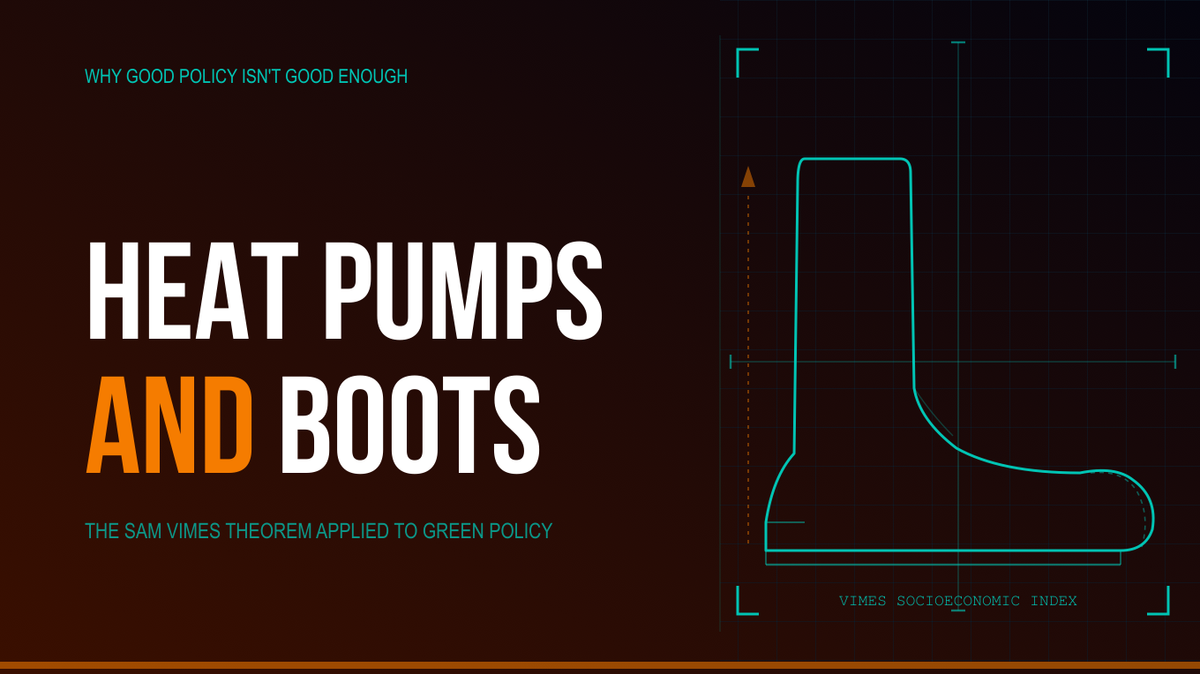
There's a concept for this, articulated — with characteristic precision — by Terry Pratchett. He's best known for the Discworld novels, and if you haven't read them, you're holding a minor but correctable misfortune in your hands. Among much else, Pratchett was a sharp and unsentimental observer of how poverty actually works. In his novel Men at Arms, the commander Sam Vimes reflects on boots.
A wealthy man, he notes, can afford a good pair of leather boots for fifty dollars. They last ten years. A poor man can only afford cheap boots for ten dollars, which fall apart in a year. So the poor man spends a hundred dollars on boots over a decade, while the rich man spends fifty — and the poor man's feet are wet the whole time besides.
Economists have adopted this as the "Boots theory of socioeconomic unfairness." It describes, with uncomfortable precision, the mechanism by which poverty is itself expensive. The households who would benefit most from cheaper running costs — the ones feeling every penny of their energy bills — are precisely the ones least able to access the technology that delivers them.
A mandate without support bakes that injustice into policy. The lower-income household ends up with the inefficient appliance, paying more to run it for fewer years before it needs replacing again. The well-off household gets the efficient one and banks the savings. Good intentions, regressive outcome. Again.
The government's consultation document acknowledges this directly. It notes that dryer ownership runs at 36% in the lowest tenth of households by income versus 73% in the highest, and concedes that lower-income households spend a higher proportion of their income on energy. Then it rates the distributional impact as "Neutral" and moves on. No support mechanism is proposed. No means-testing. The emergency replacement scenario — the broken dryer on a Tuesday — doesn't appear to be in the frame at all.
The document puts the premium at £60 rather than the £150 that reflects today's market — assuming, perhaps optimistically, that the mandate will rapidly drive down prices through competition. Even on that rosier figure, the argument stands.
The fix is not complicated
A means-tested £150 top-up for households in the bottom fifth by income who need to replace a dryer — roughly 1.5 to 2 million eligible households needing replacement at any given time — would cost £225–300 million in total. Spread across a decade of natural appliance turnover, that's a modest annual liability. Set it against what's currently spent helping the same households pay their energy bills, and it likely pays for itself.
That's the version of this policy worth having. Good environmental outcome, equitable distribution of the transition cost, and a government that has actually thought through who bears what burden.