The Victimhood Defence
A polemic
Every generation of environmental progress has had to overcome the same defensive posture: the person being asked to stop doing something harmful who reframes the request as an attack on themselves. The factory owner who called clean air regulation an assault on their livelihood. The smoker who framed no-smoking sections as persecution. And now, with impressive consistency, the car owner who, when asked to consider what their exhaust pipe does to other people, discovers that they are the victim.
The current favourite rhetorical move is the depreciation defence. The argument runs: the real cost of car ownership isn't fuel, it's depreciation and financing — therefore EV advocates who lead with fuel savings are missing the real economics. It's a reasonable point about household accounting, deployed to avoid a less comfortable conversation. It is also almost certainly temporary: EV resale values are stabilising, the premium is narrowing, and this particular line will exhaust itself sooner or later — and probably sooner if not already. Something else will replace it. It always does.
This piece is about that pattern, and what it's actually worth.
A Taxonomy
There are broadly three categories of person who push back on cleaner technology mandates. They are not morally equivalent, and they deserve different treatment.
The first is the libertarian refusenik — the "muh freedoms" contingent, for whom any policy constraint is government overreach regardless of its purpose or evidence base. There is nothing productive to say to this person, and this piece will not try.
The second is the sensory enthusiast — someone who derives pleasure from the internal combustion experience. The sound, the feel, the ritual. This is not a dishonest position. It is, in fact, the most honest version of the opposition: I like this thing, and I don't want to give it up.
The third is the economically challenged — someone for whom the cost differential between available options represents a hardship. This can be the most sympathetic case, but it's also the most frequently misused.
The Sensory Defence
The honesty of the position earns it a direct response.
The enjoyment of mechanical things is real. The internal combustion engine, whatever else it is, is a piece of engineering with genuine character. People form attachments to sensory experiences. This is human, and not contemptible.
But there is a ceiling on how far "I enjoy this" travels as a moral argument when the enjoyment has third-party victims. This principle applies universally, in every other domain. You cannot operate a noisy industrial process in a residential area because you enjoy it. You cannot discharge chemicals into a waterway because the alternative would cost you more. The fact that your pollution is distributed rather than concentrated, and normalised rather than novel, does not change its moral structure. You are still imposing costs on unconsenting others — costs measured not in inconvenience but in micrograms of particulate matter per cubic metre of lung tissue, in paediatric asthma diagnoses, in the cognitive development of children who live near roads. (For more on this, see Long tailpipes save children.)
The right to personal enjoyment stops, as a general principle, roughly where it starts damaging the unconsenting. Your right to pollute with a ute stops at my nostrils.
The Economic Defence
The affordability argument is harder, and it deserves harder engagement.
There is a spectrum of economic circumstance, and at one end of it there are people for whom any additional upfront cost is not a preference but an impossibility. That end of the spectrum is real, and policy that ignores it is both unjust and counterproductive (see Heat Pumps and Boots for an in-depth analysis).
But the affordability argument — as typically deployed in debates about EV mandates — is not usually being made by that person. It is being made by someone who has already decided to buy a new car.
This is the New Car Test, and it is surprisingly rarely applied: if you are in the market for a new vehicle, you have, by definition, discretionary capital. You have decided to spend somewhere between £20,000 and £50,000, or the dollar equivalent. The question is not whether you can afford a car. The question is whether you can afford a marginally cleaner one — and what it says about your economic circumstances that you've claimed you cannot.
The cost premium on EVs has fallen substantially and continues to fall. In many categories, on a total-cost-of-ownership basis, it has already inverted. But even where a genuine premium persists, the claim that it constitutes an unacceptable burden requires you to have already concluded you can bear the base cost.
The Depreciation Tells
Return, then, to the depreciation argument — because beyond its transitional role as the current talking point, it reveals something structural.
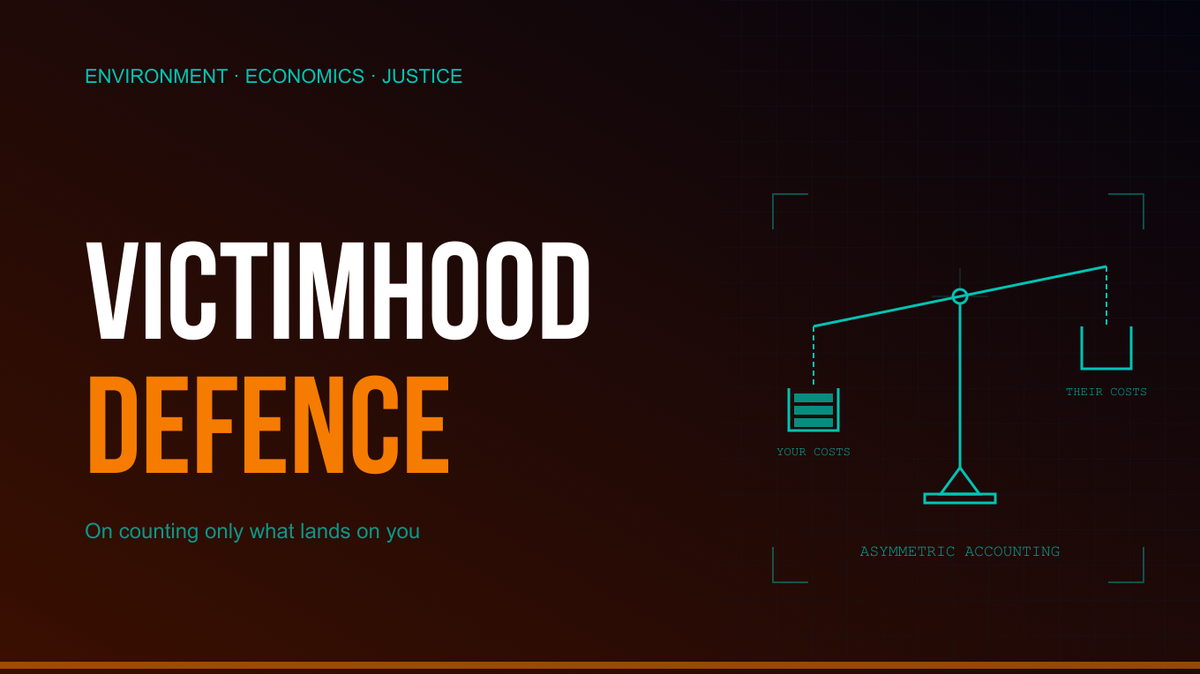
The person running depreciation and financing analysis against fuel costs is not naive about car economics. This is sophisticated multi-variable thinking. They know exactly how to calculate total cost of ownership. They have identified, with impressive precision, every cost that lands on them.
The costs that land on others simply aren't in the model.
Correctly applied, the depreciation framer is right: the biggest cost of owning a car isn't fuel. It's the cost to children's health — it just doesn't appear on your statement, because someone else is paying it. The methodology is sound. The choice of which costs to include is the problem.
This is not ignorance. It is a decision about which ledger matters. And that decision, made by someone financially literate enough to run total-cost-of-ownership calculations, is very difficult to defend as economically necessary. It is, instead, a choice about whose costs count.
The Inversion
Here is the thing that doesn't get said often enough.
The communities bearing the greatest burden of pollution are not, predominantly, the communities resisting green mandates. They are the poorest communities: the ones adjacent to arterial roads, logistics corridors, and distribution hubs. The children with elevated asthma rates, stunted lung development, and measurably reduced cognitive performance are not, by and large, the children of people arguing about depreciation schedules on social media.
So when a middle-income buyer invokes economic hardship to resist a mandate that would reduce that pollution, the justice argument is running in precisely the wrong direction. The claim is: this cost to me is unjust. The reality is: the cost you are currently externalising lands on people with less economic security than you.
Victimhood, in this framing, is the exclusive property of the person being asked to stop causing harm. The actual victims — who didn't consent, who can't opt out, who have no social media presence from which to run depreciation arguments — don't feature.
What This Is
This is not primarily a piece about electric vehicles. It is a piece about a rhetorical structure that recurs across every environmental transition: the reassignment of victim status from those bearing the costs of harmful activity to those being asked to change it.
The costs of the status quo are real. They are measured in deaths, diagnoses, and developmental damage, at a scale that dwarfs the inconvenience of the transition. They are simply measured in other people.
The question is not whether the economic concerns of those asked to change are worth considering. In genuine cases of hardship, they are, and policy should address them directly.
The question is whether those concerns, when deployed to resist any transition at all, constitute a moral argument — or just a very effective way of keeping the real accounting off the table.
This is a companion piece to Heat Pumps and Boots. It does not represent a considered policy position so much as a moral one.