Selective outrAIge
There is a particular type of social media post doing the rounds. It arrives as a video — often a reel, often several minutes long — in which the creator explains, in evident good faith, that artificial intelligence is consuming unconscionable quantities of water and electricity, and that this makes it an environmental catastrophe. The comments fill with agreement. The post gets shared. More people watch it.
Nobody seems to notice the irony.
That irony, it turns out, is quantifiable. But before getting to the numbers, it's worth asking a more basic question: what exactly is "AI," in the sense that its critics mean?
The word 'AI' means too many different things
The word has become a vessel into which almost any concern can be poured. In one breath it means the large language models that generate text, code, and conversation. In the next it means the image generators producing what critics dismissively call "silly pictures." It means the recommendation algorithms that decide whether you see the video on social media at all. It also means, though critics rarely mention this part, the systems detecting fraud on your bank account, screening medical images for cancer, predicting the path of hurricanes, and modelling protein structures that are rewriting the pace of drug discovery.
This blurring is not accidental, but it is consequential. An argument that "AI uses too much energy" only holds if it applies consistently across the whole spectrum. Applied selectively — to image generators but not to fraud detection, to chatbots but not to protein folding — it stops being an energy argument and becomes a value judgement about which applications are worth the cost. That is a different debate, and a legitimate one. But it should be conducted honestly, as what it is.
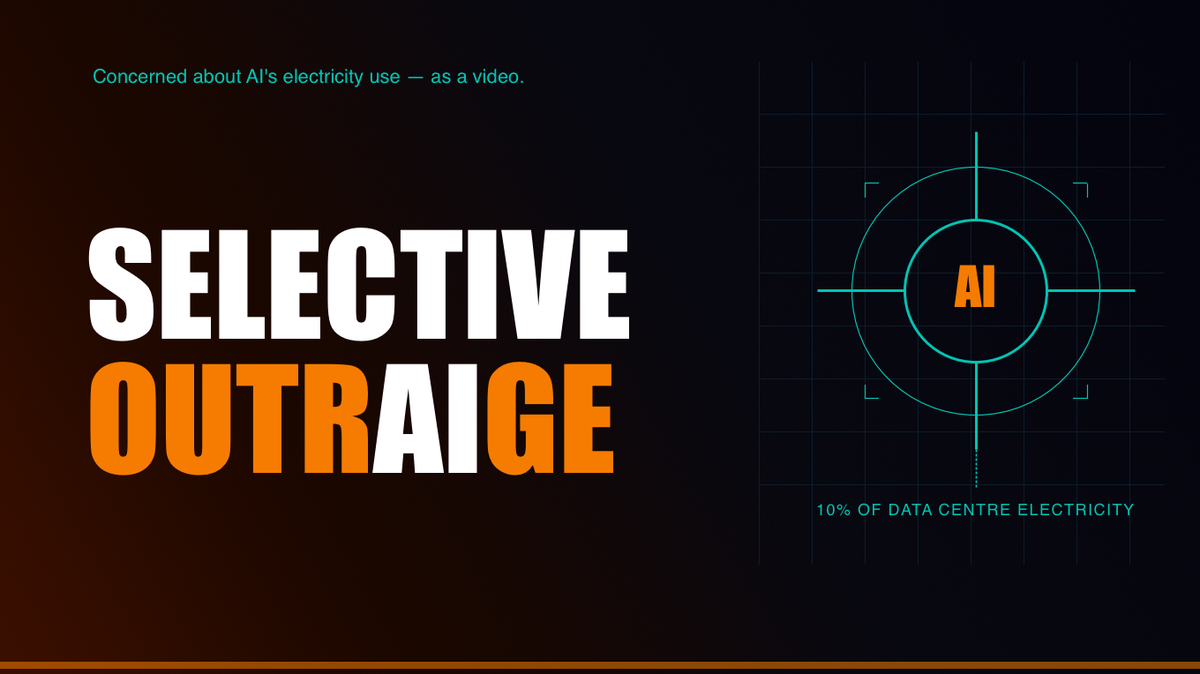
AI accounts for just 10% of data centre electricity — the other 90% predates the panic
Data centres currently account for around 1.5% of global electricity consumption. Of that, artificial intelligence — in the sense of the LLMs and generative systems that dominate the current conversation — represents approximately 10%. The remaining 90% powers everything else: cloud storage, email, every website, every streamed film, every video call, every digital photo backup, every corporate database. This infrastructure predates the current AI moment by decades, and until recently attracted almost no popular concern.
What AI is doing is adding a fast-growing load on top of that existing base. And in some regions — northern Virginia, parts of Ireland — the concentration of new AI-specific facilities is genuinely straining local grids. That is worth discussing honestly. But "AI uses too much water and electricity" as a blanket statement is not that honest discussion. It misdirects the concern toward a novel target while leaving the much larger existing base unexamined.
Video streaming: 65% of internet traffic, and six times AI's electricity use
Which brings us back to the video.
YouTube alone accounts for around 16% of global internet traffic. Netflix, at its peak, around 15%. Add Disney+, Amazon Prime, TikTok, Instagram Reels, and Facebook video, and the picture becomes clear: the internet is, to a remarkable degree, a video delivery system with other services running alongside.
The energy consequences are not small. Major streaming platforms — Netflix, YouTube, Disney+ — consume over 200 TWh of electricity annually. For comparison, AI as a whole currently accounts for around 30 TWh. Video streaming uses roughly six times more electricity than AI does right now.
To put this in terms specific to the format of the outrage: generating a single AI image at reasonable quality requires somewhere between one and four watt-hours of electricity — a one-time server-side cost. A three-minute Facebook reel, viewed by five thousand people (a modest audience for a page with tens of thousands of followers), expends several hundred times more data centre energy than the image required. Someone posting a video to Facebook to complain about AI's resource use, watching it back on YouTube, and streaming something on Netflix in the evening is personally responsible for a slice of that 65% that dwarfs, in aggregate, what AI's current footprint amounts to. Yet nobody is calling for a moratorium on Netflix.
To be precise: this argument applies specifically to video. A text post on Bluesky or X is a different matter — research puts the energy cost of a single text post at around 0.065 watt-hours, genuinely tiny, and roughly 15 to 60 times less than generating an AI image. The resource irony is proportionate to the medium. Text-based criticism, whatever one thinks of its logic, does not carry the same disproportion.
A Spotify track and a Sunday drive put the numbers in proportion
A brief note on the framing of this article. Using a Facebook video as a rhetorical foil is itself a choice, and it is fair to acknowledge it. The comparison is chosen because the numbers are stark and the irony is specific: someone posting a video to complain about AI image generation expends several hundred times more data centre energy in doing so than the image required. But the comparison extends well beyond video.
Including amortised training costs, generating a typical AI image uses roughly 3–4 watt-hours of electricity. Training is a one-time cost divided across billions of subsequent uses, and it adds less than 10% to the per-image figure. Against that baseline: streaming a four-minute song on Spotify uses approximately the same energy. Watching a two-hour film uses around fifty times more. A 50-mile weekend drive in an EV — a leisure choice, equivalent in that respect to watching a film or generating an image — uses somewhere between 4,000 and 5,000 times more. The same journey in a petrol car represents an order of magnitude beyond that in total energy input, before the combustion emissions are even considered. None of these activities attracts the kind of scrutiny currently directed at AI. The concern is real; the proportion is not.
AI's most significant contributions are invisible because they work
The selective focus on generative AI's costs would be more defensible if generative AI were the whole of what's being discussed. It isn't — but much of the rest operates in domains that rarely surface in public conversation, which makes it easy to overlook when tallying the ledger. Consider what the same broad category of technology has quietly delivered.
AlphaFold, DeepMind's protein structure prediction system, has made accurate 3D models available for over 200 million proteins — essentially the entire known protein universe — freely accessible to researchers worldwide. Before it, determining a single protein structure could take years of painstaking experimental work. Its creators received the 2024 Nobel Prize in Chemistry, which represents about as unambiguous an endorsement of usefulness as exists. The downstream effects on drug discovery and our understanding of disease are still unfolding.
In weather forecasting, Google's GraphCast model now outperforms the best conventional deterministic systems on 90% of forecast targets, producing a ten-day forecast in under a minute on a single machine — where traditional approaches require hours of computation across hundreds of servers. It predicted the path of Hurricane Lee making landfall in Nova Scotia nine days in advance. Better extreme weather prediction has direct, measurable effects on evacuation decisions and lives saved.
In drug discovery, AI-assisted approaches have compressed timelines that once ran to four to six years into processes measured in months. The first fully AI-designed drug has reached Phase II clinical trials. Hundreds of FDA submissions over the past decade have included AI components in the discovery process.
Then there are the applications so embedded in daily life that few recognise them as AI at all: the spam filters without which email would be unusable, the fraud detection systems that quietly block illegitimate transactions, the medical imaging analysis catching conditions that human review might miss. These have been running, without controversy, for fifteen to twenty years.
As is often the case, the words "baby" and "bathwater" come to mind. The spectrum has AlphaFold at one end. At the other, someone made a picture of their cat wearing a hat, and it made a stranger smile. Both ends exist. The argument against the whole spectrum on resource grounds applies equally to both — which is worth keeping in mind when the criticism is selective about which end it implies. An argument that treats the entire spectrum as equivalent, and condemns it wholesale by reference to one end, is not a rigorous argument. It is a mood.
Where the concern is real — and where it stops being precise
The energy cost of training large language models is real and worth stating plainly. Training GPT-3 consumed around 1,300 megawatt-hours of electricity and evaporated an estimated 700,000 litres of freshwater. Frontier models are substantially more energy-intensive. These figures deserve respect, not dismissal. The relevant context is that training is a one-time cost, amortised across the entire subsequent life of a model — by the time it has served billions of queries, the training energy per query is negligible. The ongoing inference cost — running the models in daily use — accounts for over 80% of AI's total electricity consumption, and it is there, not in training, that the growth trajectory is most meaningful.
None of this is to say that AI's energy trajectory is irrelevant going forward. The growth curve is real. The IEA projects that by 2030, AI-focused data centres will use roughly the same amount of electricity as all other data centres combined — a significant shift from the current 10%. In specific geographies, the concentration of new AI infrastructure is already creating genuine grid stress, with consequences for local electricity prices and reliability.
These are legitimate concerns, and they deserve precise, honest engagement. The questions worth asking are specific ones: which facilities, in which locations, drawing on which energy sources? A data centre running on hydro power in the Pacific Northwest is a different proposition from one drawing on coal in a capacity-constrained grid. Land use presents a related but distinct set of questions — data centre footprints, the space demands of the renewable infrastructure powering them, and the local planning pressures these create are all legitimate areas of scrutiny. They are also largely orthogonal to the energy argument being made here, and conflating them weakens both cases. The blanket energy argument, deployed against "AI" as an undifferentiated target, does not get anywhere near that level of precision. And precision is exactly what the subject requires.
Selective outrage is a pattern, not an argument
Selective outrage is a recognisable pattern in technology discourse — applied energetically to whatever is novel and visible, much less so to the larger, older, equally energy-intensive systems that have become unremarkable through familiarity. The current AI panic fits the pattern. The concerns buried within it are real. The framing around them is not.
The article was drafted by Claude (Anthropic) and directed and edited by mmalc Crawford. The name of this site is not accidental.